Registered Nurse
Registered Nurse
Career Overview
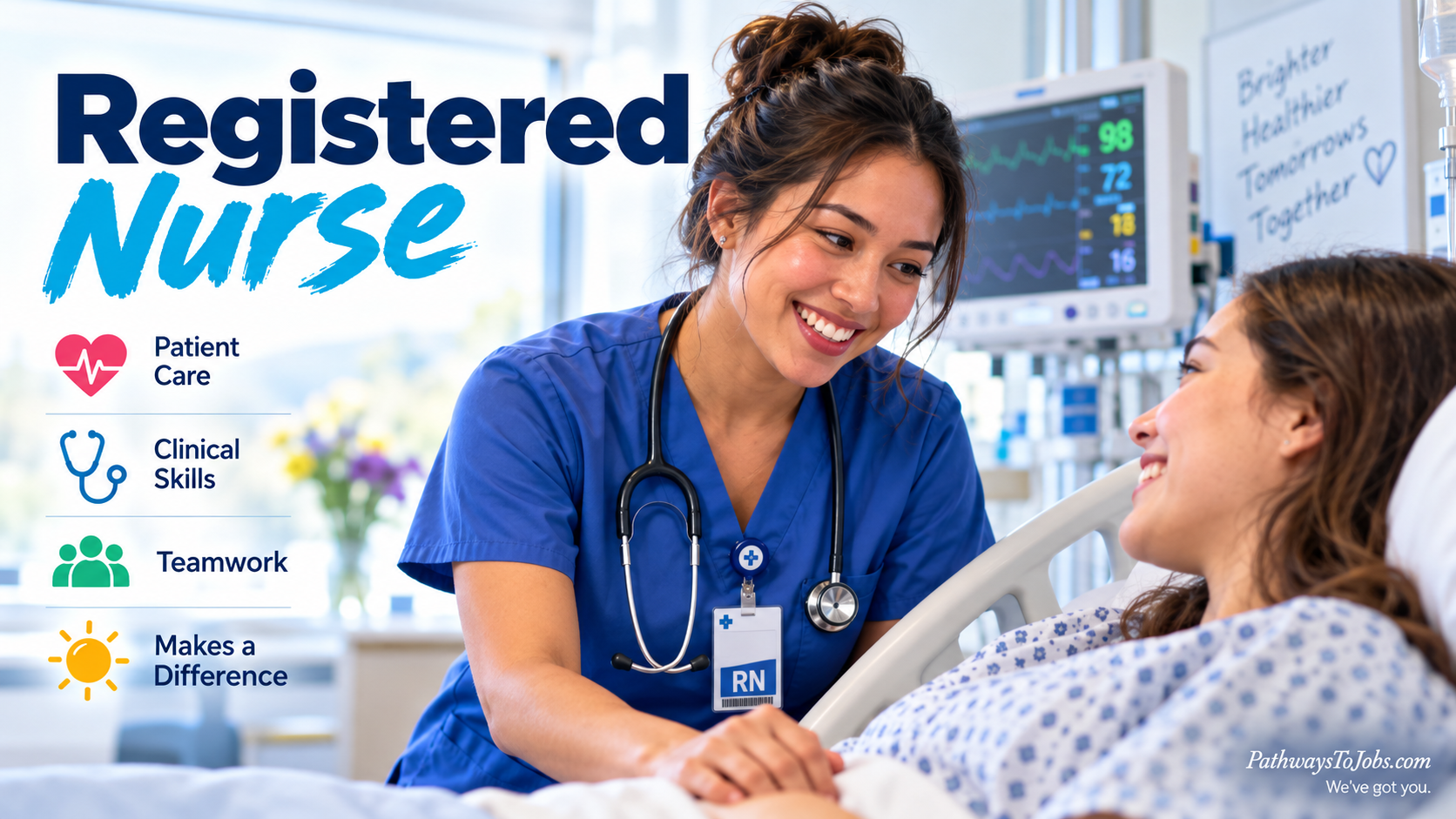
Registered nurses provide hands-on care to patients, assess their health, administer treatments and medications, monitor recovery, and work with doctors and other healthcare professionals to develop and manage care plans. RNs also educate patients and families and use electronic health records, digital monitoring systems, and increasingly AI-supported healthcare technology as part of modern nursing practice.
Education
Plan on about 4 years of postsecondary education for the most widely recognized RN pathway. Complete an approved nursing program, typically a Bachelor of Science in Nursing (BSN/BScN), including classroom study, laboratory work, and supervised clinical experience. You must then pass the required nursing licensing examination and register with the nursing regulatory body where you plan to work.
Work Environment
Registered nurses work in hospitals, clinics, doctors' offices, long-term care, community health, schools, home healthcare, and other healthcare settings. Some work in specialized areas such as emergency, intensive care, surgery, pediatrics, mental health, or critical care. Nurses may work days, nights, weekends, or rotating shifts, depending on their role. Modern RNs also work extensively with electronic health records, digital patient-monitoring equipment, telehealth, and other healthcare technologies.
Future Outlook
Nursing is expected to remain an important and in-demand career globally. An aging population, longer life expectancy, chronic diseases, and growing healthcare needs are increasing demand for nurses in many parts of the world. The World Health Organization's 2025 nursing report estimates that the world could still face a shortage of about 4.5 million nurses by 2030, despite growth in the global nursing workforce. *Nursing is also becoming more technology-driven. Electronic health records, remote monitoring, telehealth, robotics, data systems, and AI-assisted clinical tools are changing how nurses work. The technology is not replacing the need for nurses; it is changing the skills nurses use.
Recommended High School Courses
- Chemistry
- Biology
- Psychology
- Math
- Anatomy
- English
- Health science
- Active Learning - Understanding the implications of new information for both current and future problem-solving and decision-making.
- Active Listening - Giving full attention to what other people are saying, taking time to understand the points being made, asking questions as appropriate, and not interrupting at inappropriate times.
- Complex Problem Solving - Identifying complex problems and reviewing related information to develop and evaluate options and implement solutions.
- Coordination - Adjusting actions in relation to others' actions.
- Critical Thinking - Using logic and reasoning to identify the strengths and weaknesses of alternative solutions, conclusions or approaches to problems.
- Instructing - Teaching others how to do something.
- Judgment and Decision Making - Considering the relative costs and benefits of potential actions to choose the most appropriate one.
- Learning Strategies - Selecting and using training/instructional methods and procedures appropriate for the situation when learning or teaching new things.
- Monitoring - Monitoring/Assessing performance of yourself, other individuals, or organizations to make improvements or take corrective action.
- Persuasion - Persuading others to change their minds or behavior.
- Reading Comprehension - Understanding written sentences and paragraphs in work related documents.
- Service Orientation - Actively looking for ways to help people.
- Social Perceptiveness - Being aware of others' reactions and understanding why they react as they do.
- Speaking - Talking to others to convey information effectively.
- Time Management - Managing one's own time and the time of others.
- Writing - Communicating effectively in writing as appropriate for the needs of the audience.
- Biology - Knowledge of plant and animal organisms, their tissues, cells, functions, interdependencies, and interactions with each other and the environment.
- Computers and Electronics - Knowledge of circuit boards, processors, chips, electronic equipment, and computer hardware and software, including applications and programming.
- Customer and Personal Service - Knowledge of principles and processes for providing customer and personal services. This includes customer needs assessment, meeting quality standards for services, and evaluation of customer satisfaction.
- Education and Training - Knowledge of principles and methods for curriculum and training design, teaching and instruction for individuals and groups, and the measurement of training effects.
- English Language - Knowledge of the structure and content of the English language including the meaning and spelling of words, rules of composition, and grammar.
- Mathematics - Knowledge of arithmetic, algebra, geometry, calculus, statistics, and their applications.
- Medicine and Dentistry - Knowledge of the information and techniques needed to diagnose and treat human injuries, diseases, and deformities. This includes symptoms, treatment alternatives, drug properties and interactions, and preventive health-care measures.
- Psychology - Knowledge of human behavior and performance; individual differences in ability, personality, and interests; learning and motivation; psychological research methods; and the assessment and treatment of behavioral and affective disorders.
- Sociology and Anthropology - Knowledge of group behavior and dynamics, societal trends and influences, human migrations, ethnicity, cultures and their history and origins.
- Therapy and Counseling - Knowledge of principles, methods, and procedures for diagnosis, treatment, and rehabilitation of physical and mental dysfunctions, and for career counseling and guidance.
- Arm-Hand Steadiness - The ability to keep your hand and arm steady while moving your arm or while holding your arm and hand in one position.
- Category Flexibility - The ability to generate or use different sets of rules for combining or grouping things in different ways.
- Deductive Reasoning - The ability to apply general rules to specific problems to produce answers that make sense.
- Far Vision - The ability to see details at a distance.
- Finger Dexterity - The ability to make precisely coordinated movements of the fingers of one or both hands to grasp, manipulate, or assemble very small objects.
- Flexibility of Closure - The ability to identify or detect a known pattern (a figure, object, word, or sound) that is hidden in other distracting material.
- Fluency of Ideas - The ability to come up with a number of ideas about a topic (the number of ideas is important, not their quality, correctness, or creativity).
- Inductive Reasoning - The ability to combine pieces of information to form general rules or conclusions (includes finding a relationship among seemingly unrelated events).
- Information Ordering - The ability to arrange things or actions in a certain order or pattern according to a specific rule or set of rules (e.g., patterns of numbers, letters, words, pictures, mathematical operations).
- Manual Dexterity - The ability to quickly move your hand, your hand together with your arm, or your two hands to grasp, manipulate, or assemble objects.
- Memorization - The ability to remember information such as words, numbers, pictures, and procedures.
- Near Vision - The ability to see details at close range (within a few feet of the observer).
- Oral Comprehension - The ability to listen to and understand information and ideas presented through spoken words and sentences.
- Oral Expression - The ability to communicate information and ideas in speaking so others will understand.
- Perceptual Speed - The ability to quickly and accurately compare similarities and differences among sets of letters, numbers, objects, pictures, or patterns. The things to be compared may be presented at the same time or one after the other. This ability also includes comparing a presented object with a remembered object.
- Problem Sensitivity - The ability to tell when something is wrong or is likely to go wrong. It does not involve solving the problem, only recognizing there is a problem.
- Selective Attention - The ability to concentrate on a task over a period of time without being distracted.
- Speech Clarity - The ability to speak clearly so others can understand you.
- Speech Recognition - The ability to identify and understand the speech of another person.
- Stamina - The ability to exert yourself physically over long periods of time without getting winded or out of breath.
- Time Sharing - The ability to shift back and forth between two or more activities or sources of information (such as speech, sounds, touch, or other sources).
- Trunk Strength - The ability to use your abdominal and lower back muscles to support part of the body repeatedly or continuously over time without 'giving out' or fatiguing.
- Written Comprehension - The ability to read and understand information and ideas presented in writing.
- Written Expression - The ability to communicate information and ideas in writing so others will understand.
- Maintain medical facility records.
- Monitor patient conditions during treatments, procedures, or activities.
- Administer non-intravenous medications.
- Inform medical professionals regarding patient conditions and care.
- Record patient medical histories.
- Administer anesthetics or sedatives to control pain.
- Collaborate with healthcare professionals to plan or provide treatment.
- Evaluate patient outcomes to determine effectiveness of treatments.
- Immunize patients.
- Treat acute illnesses, infections, or injuries.
- Supervise patient care personnel.
- Assist healthcare practitioners during surgery.
- Assist healthcare practitioners during examinations or treatments.
- Prepare patients physically for medical procedures.
- Test biological specimens to gather information about patient conditions.
- Design public or employee health programs.
- Communicate health and wellness information to the public.
- Assess patient work, living, or social environments.
- Advise medical personnel regarding healthcare issues.
- Direct healthcare delivery programs.
- Conduct research to increase knowledge about medical issues.
- Prescribe assistive medical devices or related treatments.
- Prescribe medications.
- Maintain inventory of medical supplies or equipment.
- Prepare medical supplies or equipment for use.
- Analyze test data or images to inform diagnosis or treatment.
- Diagnose medical conditions.
- Examine patients to assess general physical condition.
- Manage healthcare operations.
- Order medical diagnostic or clinical tests.
- Treat medical emergencies.
- Train caregivers or other non-medical personnel.
- Refer patients to other healthcare practitioners or health resources.
- Advise communities or institutions regarding health or safety issues.
Schools


Potential Scholarships
Approx Salary Expectation
Related Careers

References
Trend Analysis - Explorer the Market, Labour Market Information, Government of Canada https://www.jobbank.gc.ca/trend-analysis.
O*NET OnLine, National Center for O*NET Development, https://www.onetonline.org/.