Dental Assistant
Dental Assistant
Career Overview
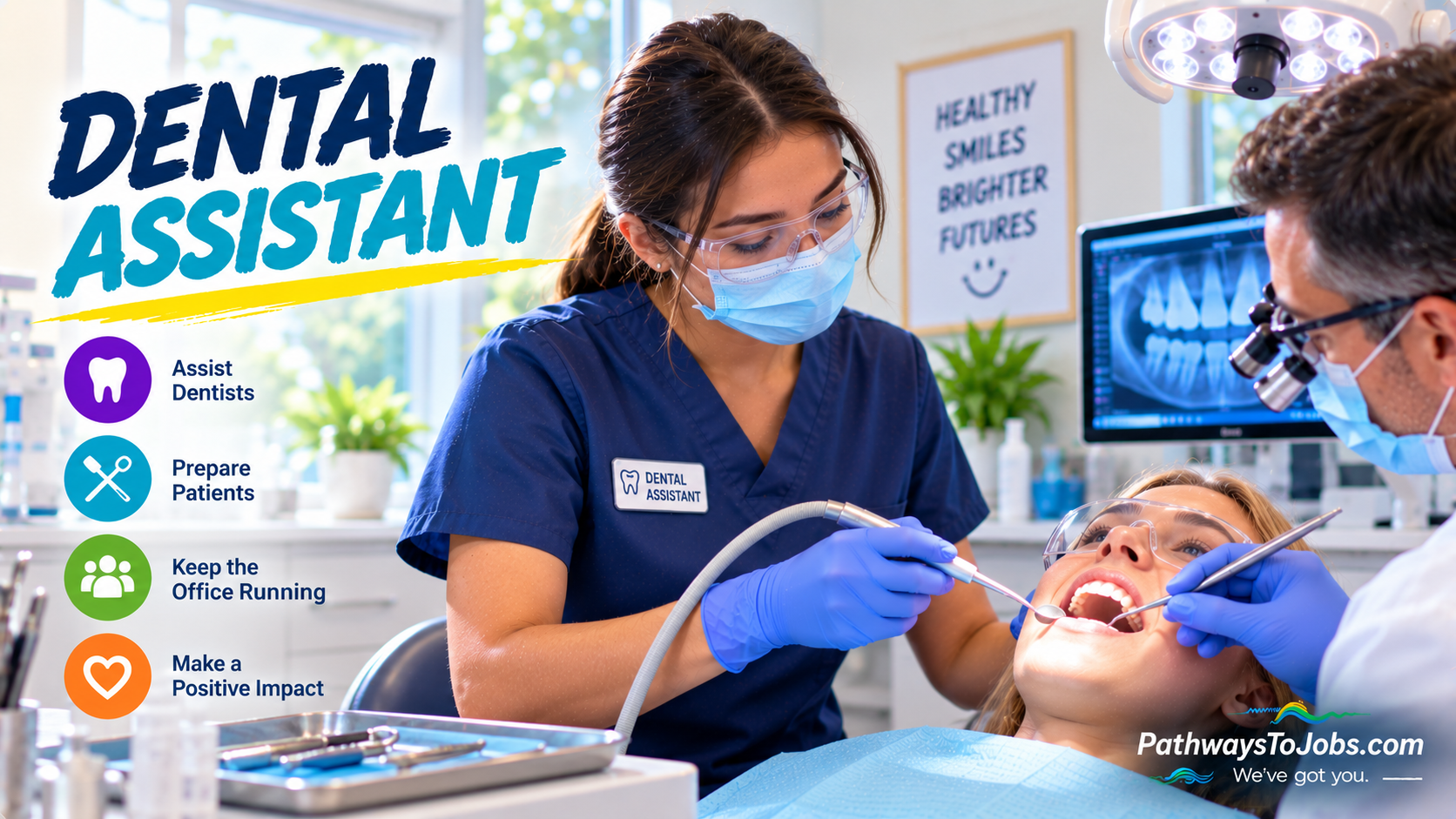
Dental assistants help dental teams provide patient care. They prepare treatment areas, assist during procedures, take and process dental images where permitted, maintain instruments, update records, and help patients feel comfortable. Digital imaging, practice-management software, and other dental technology are now part of many modern practices.
Education
Dental assistants typically complete a post-secondary dental assisting program, often taking about one year, although program length and requirements vary by location. Training combines classroom learning with hands-on clinical experience and can cover dental anatomy, infection prevention, dental instruments, patient care, imaging, and dental technology. Certification or registration may be required for certain duties.
Work Environment
Dental assistants usually work in dental offices and clinics as part of a patient-care team. The work combines hands-on patient care, technology, organization, and communication. Most work full time, although part-time schedules are also common.
Future Outlook
The outlook is positive. Employment is projected to grow 6% from 2024 to 2034 in the U.S., faster than the average for all occupations. Continued demand for preventive dental care and an aging population are expected to support opportunities, while digital tools continue to change how dental practices operate.
Recommended High School Courses
- Chemistry
- Biology
- Psychology
- Math
- Communication
- Health science
- Science
- Computer Studies
- Active Learning - Understanding the implications of new information for both current and future problem-solving and decision-making.
- Active Listening - Giving full attention to what other people are saying, taking time to understand the points being made, asking questions as appropriate, and not interrupting at inappropriate times.
- Critical Thinking - Using logic and reasoning to identify the strengths and weaknesses of alternative solutions, conclusions or approaches to problems.
- Monitoring - Monitoring/Assessing performance of yourself, other individuals, or organizations to make improvements or take corrective action.
- Reading Comprehension - Understanding written sentences and paragraphs in work related documents.
- Service Orientation - Actively looking for ways to help people.
- Social Perceptiveness - Being aware of others' reactions and understanding why they react as they do.
- Speaking - Talking to others to convey information effectively.
- Customer and Personal Service - Knowledge of principles and processes for providing customer and personal services. This includes customer needs assessment, meeting quality standards for services, and evaluation of customer satisfaction.
- Education and Training - Knowledge of principles and methods for curriculum and training design, teaching and instruction for individuals and groups, and the measurement of training effects.
- English Language - Knowledge of the structure and content of the English language including the meaning and spelling of words, rules of composition, and grammar.
- Medicine and Dentistry - Knowledge of the information and techniques needed to diagnose and treat human injuries, diseases, and deformities. This includes symptoms, treatment alternatives, drug properties and interactions, and preventive health-care measures.
- Psychology - Knowledge of human behavior and performance; individual differences in ability, personality, and interests; learning and motivation; psychological research methods; and the assessment and treatment of behavioral and affective disorders.
- Arm-Hand Steadiness - The ability to keep your hand and arm steady while moving your arm or while holding your arm and hand in one position.
- Category Flexibility - The ability to generate or use different sets of rules for combining or grouping things in different ways.
- Control Precision - The ability to quickly and repeatedly adjust the controls of a machine or a vehicle to exact positions.
- Deductive Reasoning - The ability to apply general rules to specific problems to produce answers that make sense.
- Finger Dexterity - The ability to make precisely coordinated movements of the fingers of one or both hands to grasp, manipulate, or assemble very small objects.
- Inductive Reasoning - The ability to combine pieces of information to form general rules or conclusions (includes finding a relationship among seemingly unrelated events).
- Information Ordering - The ability to arrange things or actions in a certain order or pattern according to a specific rule or set of rules (e.g., patterns of numbers, letters, words, pictures, mathematical operations).
- Manual Dexterity - The ability to quickly move your hand, your hand together with your arm, or your two hands to grasp, manipulate, or assemble objects.
- Near Vision - The ability to see details at close range (within a few feet of the observer).
- Oral Comprehension - The ability to listen to and understand information and ideas presented through spoken words and sentences.
- Oral Expression - The ability to communicate information and ideas in speaking so others will understand.
- Problem Sensitivity - The ability to tell when something is wrong or is likely to go wrong. It does not involve solving the problem, only recognizing there is a problem.
- Selective Attention - The ability to concentrate on a task over a period of time without being distracted.
- Speech Clarity - The ability to speak clearly so others can understand you.
- Speech Recognition - The ability to identify and understand the speech of another person.
- Written Comprehension - The ability to read and understand information and ideas presented in writing.
- Written Expression - The ability to communicate information and ideas in writing so others will understand.
- Assist practitioners to perform medical procedures.
- Clean medical equipment.
- Prepare medical instruments or equipment for use.
- Maintain medical records.
- Interview patients to gather medical information.
- Operate medical equipment.
- Record vital statistics or other health information.
- Explain technical medical information to patients.
- Administer basic health care or medical treatments.
- Inventory medical supplies or equipment.
- Teach medical procedures or medical equipment use to patients.
- Make patient-assistive devices or device models.
- Fit patients for assistive devices.
- Process medical billing information.
- Schedule patient procedures or appointments.
Schools


Potential Scholarships
Approx Salary Expectation
Related Careers


References
Trend Analysis - Explorer the Market, Labour Market Information, Government of Canada https://www.jobbank.gc.ca/trend-analysis.
O*NET OnLine, National Center for O*NET Development, https://www.onetonline.org/.