Dancer and choreographer
Dancer and choreographer
Career Overview
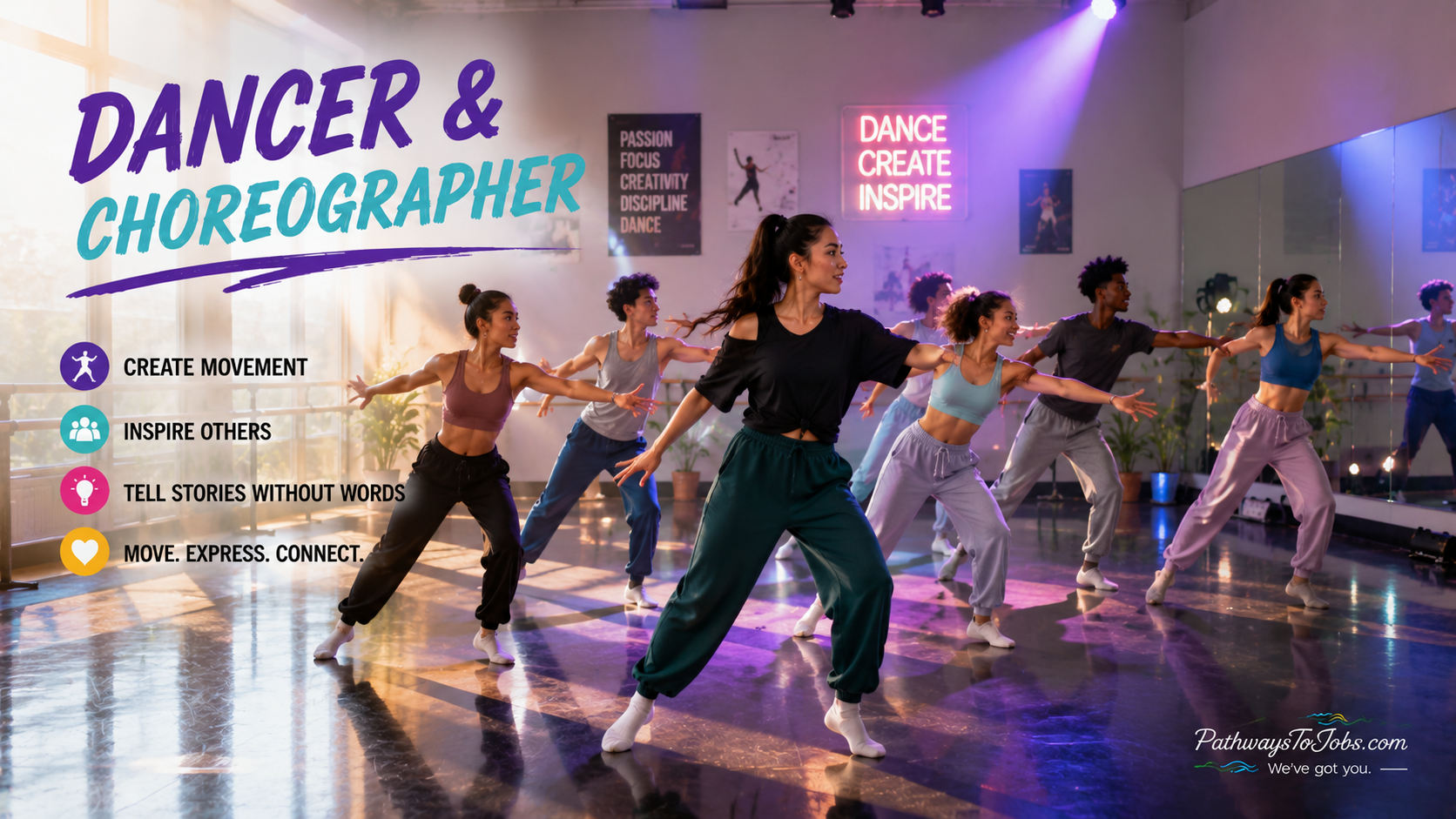
Dancers use movement to perform, express ideas, and tell stories. Choreographers create and arrange dance routines for performances, film, television, music videos, live events, and digital media. Many choreographers begin their careers as professionals
Education
Professional dancers generally need many years of specialized dance training. Choreographers usually build experience as dancers before creating choreography. A college or university dance program can provide advanced training, but a specific degree is not required for every position.
Work Environment
Dancers and choreographers work with dance companies, theatres, studios, schools, film and television productions, live events, and digital media. Work can involve intensive rehearsals, performances, touring, evenings, weekends, and periods between contracts. Many professionals are self-employed.
Future Outlook
Dance is evolving with social media, digital performance, motion-capture technology, and AI-assisted creative tools. These technologies can help create, record, and promote choreography, while human dancers and choreographers remain essential for physical performance, artistic direction, collaboration, and live interaction. Current employment projections show faster-than-average growth, particularly for choreographers, although funding and the availability of performance work can affect opportunities
Recommended High School Courses
- Dance
- Performing Arts
- Business
- Communication
- Physical Education
- English
- Drama & Theatre
- Media Arts
- Active Listening - Giving full attention to what other people are saying, taking time to understand the points being made, asking questions as appropriate, and not interrupting at inappropriate times.
- Coordination - Adjusting actions in relation to others' actions.
- Critical Thinking - Using logic and reasoning to identify the strengths and weaknesses of alternative solutions, conclusions or approaches to problems.
- English Language - Knowledge of the structure and content of the English language including the meaning and spelling of words, rules of composition, and grammar.
- Fine Arts - Knowledge of the theory and techniques required to compose, produce, and perform works of music, dance, visual arts, drama, and sculpture.
- Dynamic Flexibility - The ability to quickly and repeatedly bend, stretch, twist, or reach out with your body, arms, and/or legs.
- Dynamic Strength - The ability to exert muscle force repeatedly or continuously over time. This involves muscular endurance and resistance to muscle fatigue.
- Extent Flexibility - The ability to bend, stretch, twist, or reach with your body, arms, and/or legs.
- Gross Body Coordination - The ability to coordinate the movement of your arms, legs, and torso together when the whole body is in motion.
- Gross Body Equilibrium - The ability to keep or regain your body balance or stay upright when in an unstable position.
- Multilimb Coordination - The ability to coordinate two or more limbs (for example, two arms, two legs, or one leg and one arm) while sitting, standing, or lying down. It does not involve performing the activities while the whole body is in motion.
- Near Vision - The ability to see details at close range (within a few feet of the observer).
- Oral Comprehension - The ability to listen to and understand information and ideas presented through spoken words and sentences.
- Oral Expression - The ability to communicate information and ideas in speaking so others will understand.
- Problem Sensitivity - The ability to tell when something is wrong or is likely to go wrong. It does not involve solving the problem, only recognizing there is a problem.
- Selective Attention - The ability to concentrate on a task over a period of time without being distracted.
- Speech Recognition - The ability to identify and understand the speech of another person.
- Speed of Limb Movement - The ability to quickly move the arms and legs.
- Stamina - The ability to exert yourself physically over long periods of time without getting winded or out of breath.
- Static Strength - The ability to exert maximum muscle force to lift, push, pull, or carry objects.
- Trunk Strength - The ability to use your abdominal and lower back muscles to support part of the body repeatedly or continuously over time without 'giving out' or fatiguing.
- Repair textiles or apparel.
- Sew clothing or other articles.
- Practice athletic or artistic skills.
- Perform dances.
- Entertain public with comedic or dramatic performances.
- Audition for roles.
- Monitor current trends.
- Train others on performance techniques.
- Choreograph dances.
Schools


Potential Scholarships
Approx Salary Expectation
Related Careers



References
Trend Analysis - Explorer the Market, Labour Market Information, Government of Canada https://www.jobbank.gc.ca/trend-analysis.
O*NET OnLine, National Center for O*NET Development, https://www.onetonline.org/.