Diesel Service Techs & Mechanics
Diesel Service Techs & Mechanics
Career Overview
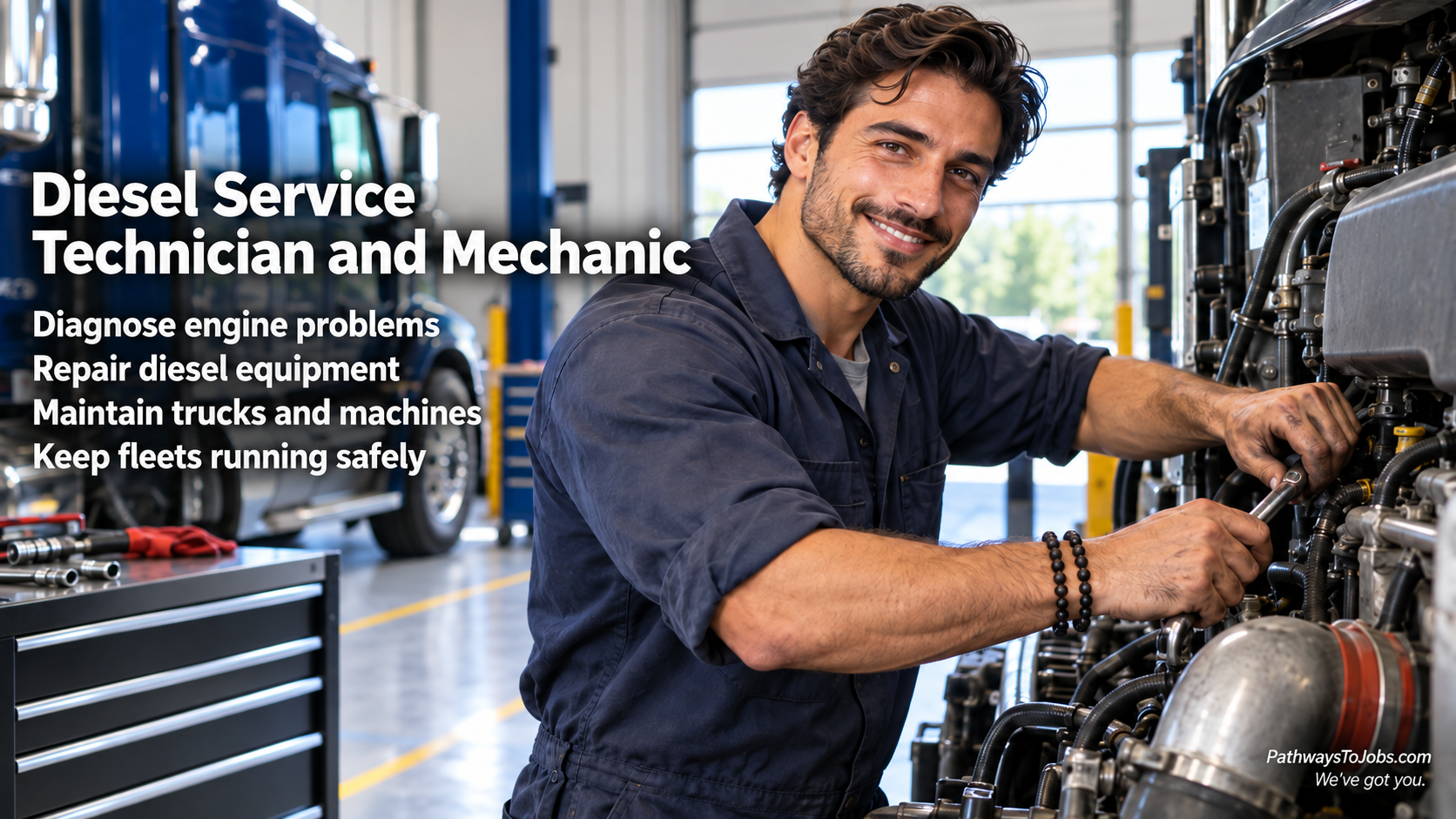
Diesel service technicians and mechanics inspect, diagnose, maintain, and repair diesel engines and systems in trucks, buses, construction equipment, and other heavy vehicles. They work with engines, transmissions, brakes, electrical systems, emissions controls, and computerized vehicle systems. Modern technicians use digital diagnostic tools, sensors, and specialized software to find problems and keep vehicles running efficiently.
Education
A high school diploma or equivalent is usually required. Post-secondary training in diesel technology, heavy vehicle mechanics, automotive technology, or a related program can improve employment opportunities, along with apprenticeship and hands-on training. Training increasingly includes electronics, computer diagnostics, emissions technology, and advanced vehicle systems.
Work Environment
Diesel technicians work in repair shops, dealerships, transportation companies, construction sites, and other industrial settings. The work is hands-on and can be noisy and physically demanding, and some technicians work evenings, weekends, overtime, or provide roadside service. Technicians may also use laptops, diagnostic scanners, and connected-vehicle technology to identify problems and monitor vehicle performance.
Future Outlook
Diesel technicians will remain needed to maintain trucks, buses, heavy equipment, and other vehicles. As vehicles become more computerized and technologically advanced, technicians with strong mechanical, electronic, and diagnostic skills should have good opportunities. Electric and alternative-fuel vehicles are also changing the industry, creating new skills and areas of specialization.
Millwright is a Red Seal trade in Canada, allowing qualified tradespeople to earn a Red Seal endorsement that is recognized across the country.
Recommended High School Courses
- Math
- Electronics
- Physics
- Welding
- English
- Manufacturing Technology
- Metal Working
- Active Learning - Understanding the implications of new information for both current and future problem-solving and decision-making.
- Active Listening - Giving full attention to what other people are saying, taking time to understand the points being made, asking questions as appropriate, and not interrupting at inappropriate times.
- Complex Problem Solving - Identifying complex problems and reviewing related information to develop and evaluate options and implement solutions.
- Critical Thinking - Using logic and reasoning to identify the strengths and weaknesses of alternative solutions, conclusions or approaches to problems.
- Equipment Maintenance - Performing routine maintenance on equipment and determining when and what kind of maintenance is needed.
- Equipment Selection - Determining the kind of tools and equipment needed to do a job.
- Judgment and Decision Making - Considering the relative costs and benefits of potential actions to choose the most appropriate one.
- Monitoring - Monitoring/Assessing performance of yourself, other individuals, or organizations to make improvements or take corrective action.
- Operation and Control - Controlling operations of equipment or systems.
- Operation Monitoring - Watching gauges, dials, or other indicators to make sure a machine is working properly.
- Quality Control Analysis - Conducting tests and inspections of products, services, or processes to evaluate quality or performance.
- Reading Comprehension - Understanding written sentences and paragraphs in work related documents.
- Repairing - Repairing machines or systems using the needed tools.
- Speaking - Talking to others to convey information effectively.
- Time Management - Managing one's own time and the time of others.
- Troubleshooting - Determining causes of operating errors and deciding what to do about it.
- Writing - Communicating effectively in writing as appropriate for the needs of the audience.
- Building and Construction - Knowledge of materials, methods, and the tools involved in the construction or repair of houses, buildings, or other structures such as highways and roads.
- Computers and Electronics - Knowledge of circuit boards, processors, chips, electronic equipment, and computer hardware and software, including applications and programming.
- Customer and Personal Service - Knowledge of principles and processes for providing customer and personal services. This includes customer needs assessment, meeting quality standards for services, and evaluation of customer satisfaction.
- Mathematics - Knowledge of arithmetic, algebra, geometry, calculus, statistics, and their applications.
- Mechanical - Knowledge of machines and tools, including their designs, uses, repair, and maintenance.
- Public Safety and Security - Knowledge of relevant equipment, policies, procedures, and strategies to promote effective local, state, or national security operations for the protection of people, data, property, and institutions.
- Arm-Hand Steadiness - The ability to keep your hand and arm steady while moving your arm or while holding your arm and hand in one position.
- Auditory Attention - The ability to focus on a single source of sound in the presence of other distracting sounds.
- Category Flexibility - The ability to generate or use different sets of rules for combining or grouping things in different ways.
- Control Precision - The ability to quickly and repeatedly adjust the controls of a machine or a vehicle to exact positions.
- Deductive Reasoning - The ability to apply general rules to specific problems to produce answers that make sense.
- Extent Flexibility - The ability to bend, stretch, twist, or reach with your body, arms, and/or legs.
- Far Vision - The ability to see details at a distance.
- Finger Dexterity - The ability to make precisely coordinated movements of the fingers of one or both hands to grasp, manipulate, or assemble very small objects.
- Flexibility of Closure - The ability to identify or detect a known pattern (a figure, object, word, or sound) that is hidden in other distracting material.
- Hearing Sensitivity - The ability to detect or tell the differences between sounds that vary in pitch and loudness.
- Inductive Reasoning - The ability to combine pieces of information to form general rules or conclusions (includes finding a relationship among seemingly unrelated events).
- Information Ordering - The ability to arrange things or actions in a certain order or pattern according to a specific rule or set of rules (e.g., patterns of numbers, letters, words, pictures, mathematical operations).
- Manual Dexterity - The ability to quickly move your hand, your hand together with your arm, or your two hands to grasp, manipulate, or assemble objects.
- Multilimb Coordination - The ability to coordinate two or more limbs (for example, two arms, two legs, or one leg and one arm) while sitting, standing, or lying down. It does not involve performing the activities while the whole body is in motion.
- Near Vision - The ability to see details at close range (within a few feet of the observer).
- Oral Comprehension - The ability to listen to and understand information and ideas presented through spoken words and sentences.
- Oral Expression - The ability to communicate information and ideas in speaking so others will understand.
- Perceptual Speed - The ability to quickly and accurately compare similarities and differences among sets of letters, numbers, objects, pictures, or patterns. The things to be compared may be presented at the same time or one after the other. This ability also includes comparing a presented object with a remembered object.
- Problem Sensitivity - The ability to tell when something is wrong or is likely to go wrong. It does not involve solving the problem, only recognizing there is a problem.
- Rate Control - The ability to time your movements or the movement of a piece of equipment in anticipation of changes in the speed and/or direction of a moving object or scene.
- Reaction Time - The ability to quickly respond (with the hand, finger, or foot) to a signal (sound, light, picture) when it appears.
- Response Orientation - The ability to choose quickly between two or more movements in response to two or more different signals (lights, sounds, pictures). It includes the speed with which the correct response is started with the hand, foot, or other body part.
- Selective Attention - The ability to concentrate on a task over a period of time without being distracted.
- Speech Clarity - The ability to speak clearly so others can understand you.
- Speech Recognition - The ability to identify and understand the speech of another person.
- Static Strength - The ability to exert maximum muscle force to lift, push, pull, or carry objects.
- Trunk Strength - The ability to use your abdominal and lower back muscles to support part of the body repeatedly or continuously over time without 'giving out' or fatiguing.
- Visual Color Discrimination - The ability to match or detect differences between colors, including shades of color and brightness.
- Visualization - The ability to imagine how something will look after it is moved around or when its parts are moved or rearranged.
- Written Comprehension - The ability to read and understand information and ideas presented in writing.
- Repair worn, damaged, or defective mechanical parts.
- Inspect completed work to ensure proper functioning.
- Replace worn, damaged, or defective mechanical parts.
- Inspect mechanical equipment to locate damage, defects, or wear.
- Operate transportation equipment to demonstrate function or malfunction.
- Read technical information needed to perform maintenance or repairs.
- Dismantle heavy equipment or machinery.
- Reassemble equipment after repair.
- Adjust equipment to ensure optimal performance.
- Maintain work equipment or machinery.
- Repair electrical components.
- Rewire electrical or electronic systems.
- Test mechanical equipment to ensure proper functioning.
- Troubleshoot equipment or systems operation problems.
- Inspect mechanical components of vehicles to identify problems.
- Operate welding equipment.
- Solder parts or connections between parts.
- Maintain inventories of materials, equipment, or products.
- Maintain repair or maintenance records.
- Order materials, supplies, or equipment.
- Schedule repair, installation or maintenance activities.
- Clean equipment, parts, or tools to repair or maintain them in good working order.
- Lubricate equipment to allow proper functioning.
- Align equipment or machinery.
- Assemble mechanical components or machine parts.
- Fabricate parts or components.
- Supervise employees.
Schools


Potential Scholarships
Approx Salary Expectation
Related Careers



References
Trend Analysis - Explorer the Market, Labour Market Information, Government of Canada https://www.jobbank.gc.ca/trend-analysis.
O*NET OnLine, National Center for O*NET Development, https://www.onetonline.org/.