Automotive Service Technician
Automotive Service Technician
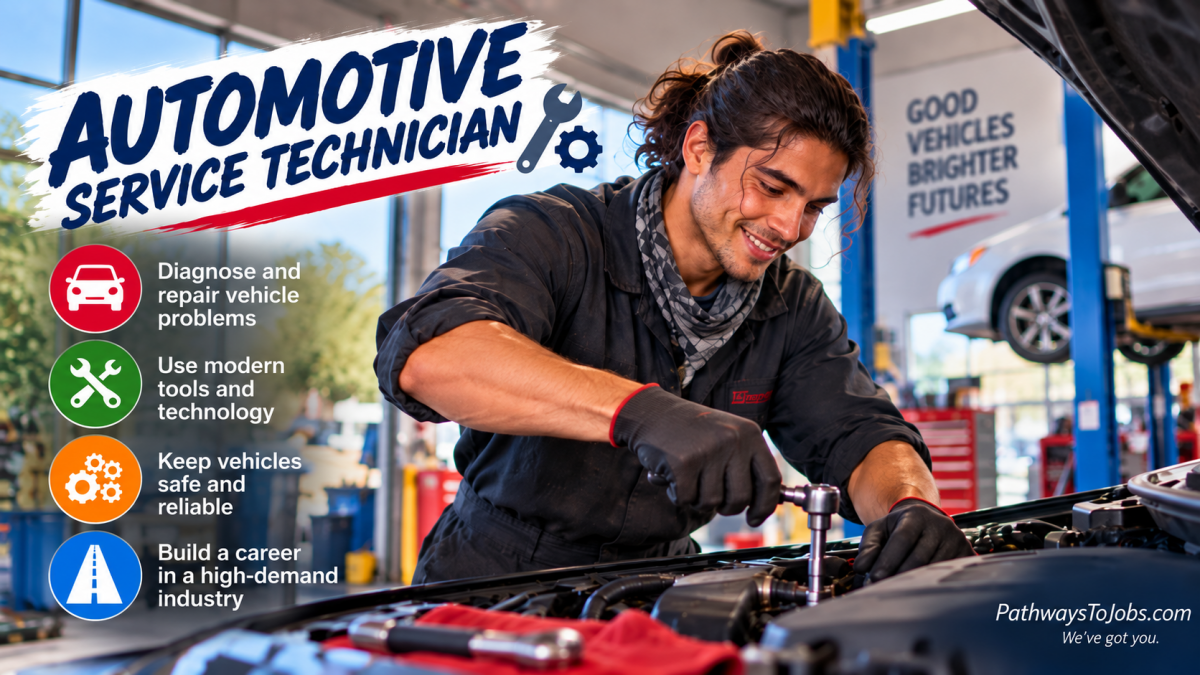
Career Overview
Automotive service technicians inspect, diagnose, maintain, and repair cars and light trucks. Today's automotive technicians work with computerized diagnostics, electronic systems, sensors, hybrid and electric vehicles, and advanced driver-assistance systems such as adaptive cruise control and lane-keeping technology.
Education
A high school diploma or equivalent is a common starting point, followed by an automotive service technology program and/or apprenticeship training. Students gain hands-on experience in vehicle diagnostics, repair, maintenance, electrical systems, engines, brakes, and modern automotive technology. * Red Seal Eligible in Canada
Work Environment
Automotive technicians work in dealerships, repair shops, specialty garages, and fleet service facilities. The work is hands-on and can involve standing, bending, lifting, noise, fumes, and working in tight spaces. Technicians now use scan tools, laptops, digital service information, electronic testing equipment, and specialized software as part of everyday repairs.
Future Outlook
Cars are becoming more computerized, connected, and electrified, creating new opportunities for technicians who can work with both mechanical and electronic systems. Electric vehicles may require less routine maintenance, but technicians will increasingly need skills in diagnostics, high-voltage systems, sensors, software, and advanced safety technology.
Recommended High School Courses
- Electronics
- Physics
- Communication
- Automotive Repair
- Technology
- Active Learning - Understanding the implications of new information for both current and future problem-solving and decision-making.
- Active Listening - Giving full attention to what other people are saying, taking time to understand the points being made, asking questions as appropriate, and not interrupting at inappropriate times.
- Complex Problem Solving - Identifying complex problems and reviewing related information to develop and evaluate options and implement solutions.
- Critical Thinking - Using logic and reasoning to identify the strengths and weaknesses of alternative solutions, conclusions or approaches to problems.
- Equipment Maintenance - Performing routine maintenance on equipment and determining when and what kind of maintenance is needed.
- Equipment Selection - Determining the kind of tools and equipment needed to do a job.
- Judgment and Decision Making - Considering the relative costs and benefits of potential actions to choose the most appropriate one.
- Operation and Control - Controlling operations of equipment or systems.
- Operation Monitoring - Watching gauges, dials, or other indicators to make sure a machine is working properly.
- Quality Control Analysis - Conducting tests and inspections of products, services, or processes to evaluate quality or performance.
- Reading Comprehension - Understanding written sentences and paragraphs in work related documents.
- Repairing - Repairing machines or systems using the needed tools.
- Speaking - Talking to others to convey information effectively.
- Time Management - Managing one's own time and the time of others.
- Troubleshooting - Determining causes of operating errors and deciding what to do about it.
- Computers and Electronics - Knowledge of circuit boards, processors, chips, electronic equipment, and computer hardware and software, including applications and programming.
- Customer and Personal Service - Knowledge of principles and processes for providing customer and personal services. This includes customer needs assessment, meeting quality standards for services, and evaluation of customer satisfaction.
- Engineering and Technology - Knowledge of the practical application of engineering science and technology. This includes applying principles, techniques, procedures, and equipment to the design and production of various goods and services.
- English Language - Knowledge of the structure and content of the English language including the meaning and spelling of words, rules of composition, and grammar.
- Mechanical - Knowledge of machines and tools, including their designs, uses, repair, and maintenance.
- Arm-Hand Steadiness - The ability to keep your hand and arm steady while moving your arm or while holding your arm and hand in one position.
- Auditory Attention - The ability to focus on a single source of sound in the presence of other distracting sounds.
- Category Flexibility - The ability to generate or use different sets of rules for combining or grouping things in different ways.
- Control Precision - The ability to quickly and repeatedly adjust the controls of a machine or a vehicle to exact positions.
- Deductive Reasoning - The ability to apply general rules to specific problems to produce answers that make sense.
- Finger Dexterity - The ability to make precisely coordinated movements of the fingers of one or both hands to grasp, manipulate, or assemble very small objects.
- Flexibility of Closure - The ability to identify or detect a known pattern (a figure, object, word, or sound) that is hidden in other distracting material.
- Hearing Sensitivity - The ability to detect or tell the differences between sounds that vary in pitch and loudness.
- Inductive Reasoning - The ability to combine pieces of information to form general rules or conclusions (includes finding a relationship among seemingly unrelated events).
- Information Ordering - The ability to arrange things or actions in a certain order or pattern according to a specific rule or set of rules (e.g., patterns of numbers, letters, words, pictures, mathematical operations).
- Manual Dexterity - The ability to quickly move your hand, your hand together with your arm, or your two hands to grasp, manipulate, or assemble objects.
- Multilimb Coordination - The ability to coordinate two or more limbs (for example, two arms, two legs, or one leg and one arm) while sitting, standing, or lying down. It does not involve performing the activities while the whole body is in motion.
- Near Vision - The ability to see details at close range (within a few feet of the observer).
- Oral Comprehension - The ability to listen to and understand information and ideas presented through spoken words and sentences.
- Oral Comprehension - The ability to listen to and understand information and ideas presented through spoken words and sentences.See more occupations related to this ability.
- Oral Expression - The ability to communicate information and ideas in speaking so others will understand.
- Perceptual Speed - The ability to quickly and accurately compare similarities and differences among sets of letters, numbers, objects, pictures, or patterns. The things to be compared may be presented at the same time or one after the other. This ability also includes comparing a presented object with a remembered object.
- Problem Sensitivity - The ability to tell when something is wrong or is likely to go wrong. It does not involve solving the problem, only recognizing there is a problem.
- Reaction Time - The ability to quickly respond (with the hand, finger, or foot) to a signal (sound, light, picture) when it appears.
- Selective Attention - The ability to concentrate on a task over a period of time without being distracted.
- Speech Recognition - The ability to identify and understand the speech of another person.
- Trunk Strength - The ability to use your abdominal and lower back muscles to support part of the body repeatedly or continuously over time without 'giving out' or fatiguing.
- Visual Color Discrimination - The ability to match or detect differences between colors, including shades of color and brightness.
- Visualization - The ability to imagine how something will look after it is moved around or when its parts are moved or rearranged.
- Written Comprehension - The ability to read and understand information and ideas presented in writing.
- Operate transportation equipment to demonstrate function or malfunction.
- Adjust equipment to ensure optimal performance.
- Inspect vehicles to determine overall condition.
- Record information about parts, materials or repair procedures.
- Test mechanical systems to ensure proper functioning.
- Replace worn, damaged, or defective mechanical parts.
- Adjust vehicle components according to specifications.
- Repair non-engine automotive or vehicle components.
- Confer with coworkers to coordinate work activities.
- Estimate costs for labor or materials.
- Read work orders or descriptions of problems to determine repairs or modifications needed.
- Troubleshoot equipment or systems operation problems.
- Confer with customers or users to assess problems.
- Align equipment or machinery.
- Disassemble equipment for maintenance or repair.
- Reassemble equipment after repair.
- Test electrical circuits or components for proper functioning.
- Clean work areas.
- Inspect mechanical components of vehicles to identify problems.
- Plan work procedures.
- Service vehicles to maintain functionality.
- Repair worn, damaged, or defective mechanical parts.
- Disassemble equipment to inspect for deficiencies.
- Repair defective engines or engine components.
- Service heating, ventilation or air-conditioning (HVAC) systems or components.
- Service green vehicles to make repairs or maintain good working order.
- Rebuild parts or components.
- Inspect gas systems or components to identify leaks or other potential hazards.
- Rewire electrical or electronic systems.
- Install vehicle parts or accessories.
Schools


Potential Scholarships
Approx Salary Expectation
Related Careers




References
Trend Analysis - Explorer the Market, Labour Market Information, Government of Canada https://www.jobbank.gc.ca/trend-analysis.
O*NET OnLine, National Center for O*NET Development, https://www.onetonline.org/.