Farm Equipment Mechanic
Farm Equipment Mechanic
Career Overview
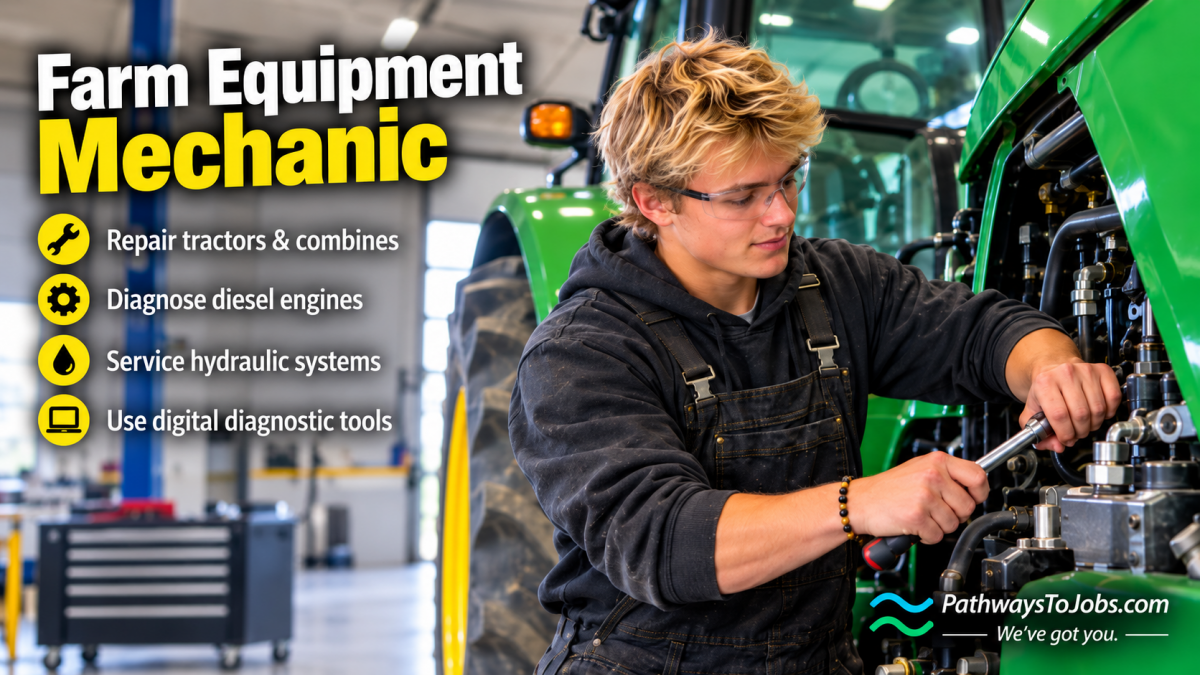
Farm equipment mechanics maintain, diagnose, and repair the machines used in modern farming. They work on tractors, combines, harvesters, irrigation systems, and other agricultural equipment. They use mechanical, electrical, hydraulic, and computer systems to find problems, replace parts, and keep equipment working safely and efficiently.
Education
A high school diploma or equivalent is a common starting point, followed by technical training, an apprenticeship, or on-the-job training. In Canada, Agricultural Equipment Technician is a recognized skilled trade, with apprenticeship programs available across the country. In the U.S., many workers complete a vocational or technical program before entering the field. * Red Seal Eligible in Canada.
Work Environment
Farm equipment mechanics may work in repair shops, equipment dealerships, farm operations, or in the field. The job can involve working with large machines, heavy parts, tools, grease, noise, and changing weather conditions. Field technicians may travel to farms to diagnose and repair equipment in the field.
Future Outlook
Modern farm equipment is becoming more computerized, automated, and connected, creating new opportunities for mechanics who understand both machines and technology. GPS, sensors, electronic controls, precision farming systems, and advanced diagnostics are becoming part of the work. Skilled technicians who can troubleshoot mechanical, electrical, hydraulic, and computer-controlled systems should continue to be valuable.
Recommended High School Courses
- Math
- Physics
- Agricultural Science
- Computer Studies
- Technology
- Mechanics
- Active Learning - Understanding the implications of new information for both current and future problem-solving and decision-making.
- Active Listening - Giving full attention to what other people are saying, taking time to understand the points being made, asking questions as appropriate, and not interrupting at inappropriate times.
- Complex Problem Solving - Identifying complex problems and reviewing related information to develop and evaluate options and implement solutions.
- Critical Thinking - Using logic and reasoning to identify the strengths and weaknesses of alternative solutions, conclusions or approaches to problems.
- Equipment Maintenance - Performing routine maintenance on equipment and determining when and what kind of maintenance is needed.
- Equipment Selection - Determining the kind of tools and equipment needed to do a job.
- Judgment and Decision Making - Considering the relative costs and benefits of potential actions to choose the most appropriate one.
- Monitoring - Monitoring/Assessing performance of yourself, other individuals, or organizations to make improvements or take corrective action.
- Operation and Control - Controlling operations of equipment or systems.
- Operation Monitoring - Watching gauges, dials, or other indicators to make sure a machine is working properly.
- Quality Control Analysis - Conducting tests and inspections of products, services, or processes to evaluate quality or performance.
- Reading Comprehension - Understanding written sentences and paragraphs in work related documents.
- Repairing - Repairing machines or systems using the needed tools.
- Speaking - Talking to others to convey information effectively.
- Troubleshooting - Determining causes of operating errors and deciding what to do about it.
- Administration and Management - Knowledge of business and management principles involved in strategic planning, resource allocation, human resources modeling, leadership technique, production methods, and coordination of people and resources.
- Computers and Electronics - Knowledge of circuit boards, processors, chips, electronic equipment, and computer hardware and software, including applications and programming.
- Customer and Personal Service - Knowledge of principles and processes for providing customer and personal services. This includes customer needs assessment, meeting quality standards for services, and evaluation of customer satisfaction.
- Education and Training - Knowledge of principles and methods for curriculum and training design, teaching and instruction for individuals and groups, and the measurement of training effects.
- Engineering and Technology - Knowledge of the practical application of engineering science and technology. This includes applying principles, techniques, procedures, and equipment to the design and production of various goods and services.
- English Language - Knowledge of the structure and content of the English language including the meaning and spelling of words, rules of composition, and grammar.
- Mathematics - Knowledge of arithmetic, algebra, geometry, calculus, statistics, and their applications.
- Mechanical - Knowledge of machines and tools, including their designs, uses, repair, and maintenance.
- Arm-Hand Steadiness - The ability to keep your hand and arm steady while moving your arm or while holding your arm and hand in one position.
- Auditory Attention - The ability to focus on a single source of sound in the presence of other distracting sounds.
- Category Flexibility - The ability to generate or use different sets of rules for combining or grouping things in different ways.
- Control Precision - The ability to quickly and repeatedly adjust the controls of a machine or a vehicle to exact positions.
- Deductive Reasoning - The ability to apply general rules to specific problems to produce answers that make sense.
- Depth Perception - The ability to judge which of several objects is closer or farther away from you, or to judge the distance between you and an object.
- Dynamic Strength - The ability to exert muscle force repeatedly or continuously over time. This involves muscular endurance and resistance to muscle fatigue.
- Extent Flexibility - The ability to bend, stretch, twist, or reach with your body, arms, and/or legs.
- Finger Dexterity - The ability to make precisely coordinated movements of the fingers of one or both hands to grasp, manipulate, or assemble very small objects.
- Flexibility of Closure - The ability to identify or detect a known pattern (a figure, object, word, or sound) that is hidden in other distracting material.
- Hearing Sensitivity - The ability to detect or tell the differences between sounds that vary in pitch and loudness.
- Inductive Reasoning - The ability to combine pieces of information to form general rules or conclusions (includes finding a relationship among seemingly unrelated events).
- Information Ordering - The ability to arrange things or actions in a certain order or pattern according to a specific rule or set of rules (e.g., patterns of numbers, letters, words, pictures, mathematical operations).
- Manual Dexterity - The ability to quickly move your hand, your hand together with your arm, or your two hands to grasp, manipulate, or assemble objects.
- Multilimb Coordination - The ability to coordinate two or more limbs (for example, two arms, two legs, or one leg and one arm) while sitting, standing, or lying down. It does not involve performing the activities while the whole body is in motion.
- Near Vision - The ability to see details at close range (within a few feet of the observer).
- Oral Comprehension - The ability to listen to and understand information and ideas presented through spoken words and sentences.
- Oral Expression - The ability to communicate information and ideas in speaking so others will understand.
- Perceptual Speed - The ability to quickly and accurately compare similarities and differences among sets of letters, numbers, objects, pictures, or patterns. The things to be compared may be presented at the same time or one after the other. This ability also includes comparing a presented object with a remembered object.
- Problem Sensitivity - The ability to tell when something is wrong or is likely to go wrong. It does not involve solving the problem, only recognizing there is a problem.
- Reaction Time - The ability to quickly respond (with the hand, finger, or foot) to a signal (sound, light, picture) when it appears.
- Response Orientation - The ability to choose quickly between two or more movements in response to two or more different signals (lights, sounds, pictures). It includes the speed with which the correct response is started with the hand, foot, or other body part.
- Selective Attention - The ability to concentrate on a task over a period of time without being distracted.
- Speech Clarity - The ability to speak clearly so others can understand you.
- Speech Recognition - The ability to identify and understand the speech of another person.
- Static Strength - The ability to exert maximum muscle force to lift, push, pull, or carry objects.
- Trunk Strength - The ability to use your abdominal and lower back muscles to support part of the body repeatedly or continuously over time without 'giving out' or fatiguing.
- Visual Color Discrimination - The ability to match or detect differences between colors, including shades of color and brightness.
- Visualization - The ability to imagine how something will look after it is moved around or when its parts are moved or rearranged.
- Wrist-Finger Speed - The ability to make fast, simple, repeated movements of the fingers, hands, and wrists.
- Written Comprehension - The ability to read and understand information and ideas presented in writing.
- Disassemble equipment for maintenance or repair.
- Repair defective engines or engine components.
- Service vehicles to maintain functionality.
- Adjust equipment to ensure optimal performance.
- Maintain repair or maintenance records.
- Reassemble equipment after repair.
- Test mechanical equipment to ensure proper functioning.
- Clean equipment, parts, or tools to repair or maintain them in good working order.
- Lubricate equipment to allow proper functioning.
- Install machine or equipment replacement parts.
- Test electrical circuits or components for proper functioning.
- Adjust vehicle components according to specifications.
- Confer with customers or users to assess problems.
- Inspect mechanical equipment to locate damage, defects, or wear.
- Read work orders or descriptions of problems to determine repairs or modifications needed.
- Repair worn, damaged, or defective mechanical parts.
- Replace worn, damaged, or defective mechanical parts.
- Move large objects using heavy equipment.
- Fabricate parts or components.
- Repair structural components.
- Install piping for installation or maintenance activities.
- Repair pipes to stop leaking.
Schools


Potential Scholarships
Approx Salary Expectation
Related Careers

_v2_139.png)

References
Trend Analysis - Explorer the Market, Labour Market Information, Government of Canada https://www.jobbank.gc.ca/trend-analysis.
O*NET OnLine, National Center for O*NET Development, https://www.onetonline.org/.