Archivist
Archivist
Career Overview
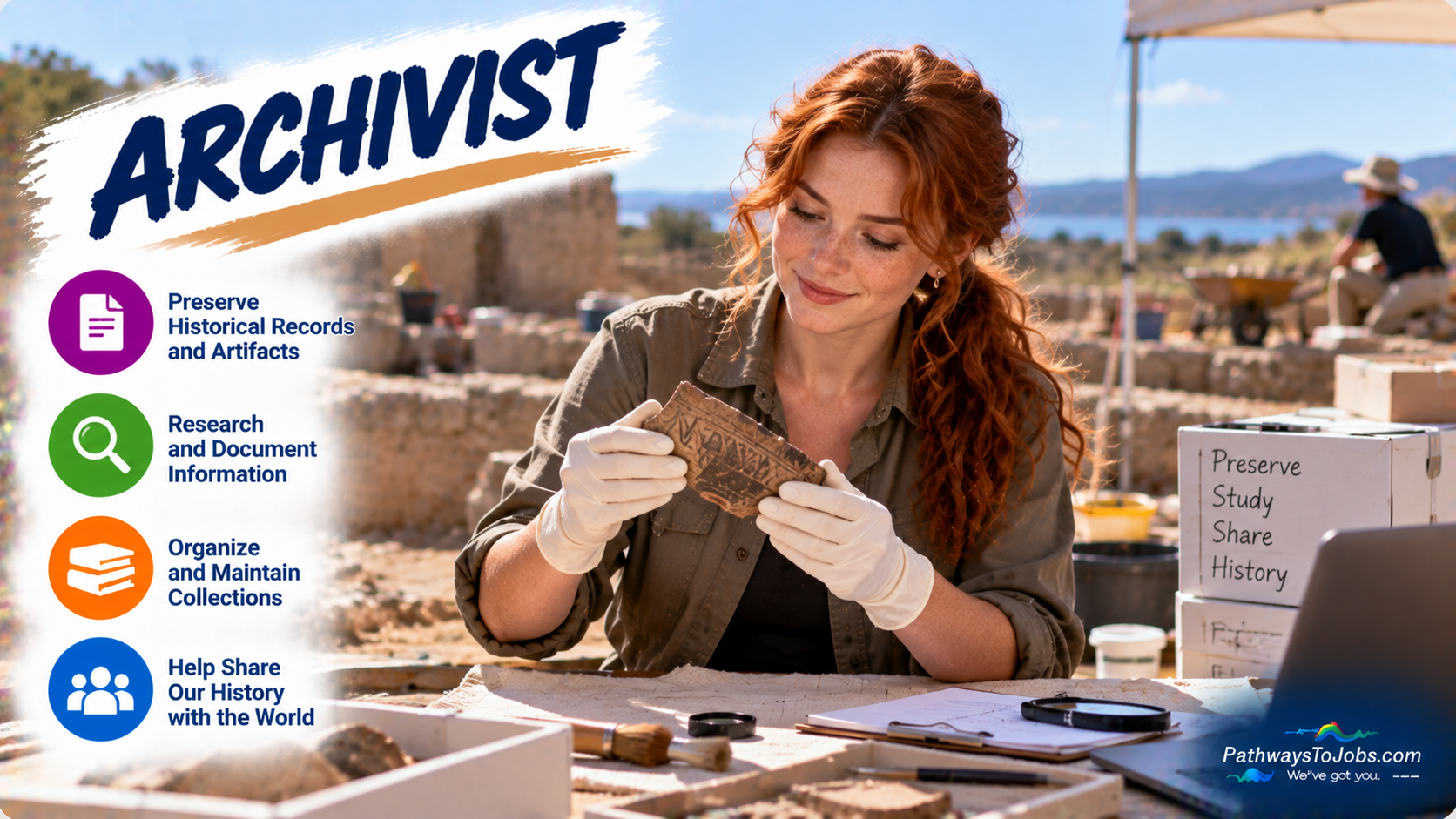
Archivists preserve and organize important records, documents, photographs, films, maps, and digital files so they can be discovered and understood for years to come. It's a career that combines history, research, technology and information management. Modern archivists also work with digital archives, databases, digitization and emerging AI tools.
Education
Requirements vary by location and employer. A university degree with archival studies is commonly required, while some positions may require a master's degree in archival studies, library and information science, history, or a related field. Internships and volunteer experience can be valuable.
Work Environment
Archivists work in museums, libraries, universities, government organizations, historical institutions, corporations, and other organizations with valuable records. They may work with physical collections, digital archives, databases, and specialized preservation technology.
Future Outlook
As organizations create more digital records and digitize historical collections, archivists will play an important role in organizing, preserving and making information accessible. AI, digital preservation and information technology are creating new ways to manage and explore the past.
Recommended High School Courses
- Art
- Political Science
- Writing
- Communication
- History
- English
- Research
- Computer Studies
- Media Studies
- Active Learning - Understanding the implications of new information for both current and future problem-solving and decision-making.
- Active Listening - Giving full attention to what other people are saying, taking time to understand the points being made, asking questions as appropriate, and not interrupting at inappropriate times.
- Complex Problem Solving - Identifying complex problems and reviewing related information to develop and evaluate options and implement solutions.
- Coordination - Adjusting actions in relation to others' actions.
- Critical Thinking - Using logic and reasoning to identify the strengths and weaknesses of alternative solutions, conclusions or approaches to problems.
- Instructing - Teaching others how to do something.
- Judgment and Decision Making - Considering the relative costs and benefits of potential actions to choose the most appropriate one.
- Monitoring - Monitoring/Assessing performance of yourself, other individuals, or organizations to make improvements or take corrective action.
- Reading Comprehension - Understanding written sentences and paragraphs in work related documents.
- Service Orientation - Actively looking for ways to help people.
- Speaking - Talking to others to convey information effectively.
- Time Management - Managing one's own time and the time of others.
- Writing - Communicating effectively in writing as appropriate for the needs of the audience.
- Administration and Management - Knowledge of business and management principles involved in strategic planning, resource allocation, human resources modeling, leadership technique, production methods, and coordination of people and resources.
- Clerical - Knowledge of administrative and clerical procedures and systems such as word processing, managing files and records, stenography and transcription, designing forms, and other office procedures and terminology.
- Computers and Electronics - Knowledge of circuit boards, processors, chips, electronic equipment, and computer hardware and software, including applications and programming.
- Customer and Personal Service - Knowledge of principles and processes for providing customer and personal services. This includes customer needs assessment, meeting quality standards for services, and evaluation of customer satisfaction.
- Education and Training - Knowledge of principles and methods for curriculum and training design, teaching and instruction for individuals and groups, and the measurement of training effects.
- English Language - Knowledge of the structure and content of the English language including the meaning and spelling of words, rules of composition, and grammar.
- History and Archeology - Knowledge of historical events and their causes, indicators, and effects on civilizations and cultures.
- Category Flexibility - The ability to generate or use different sets of rules for combining or grouping things in different ways.
- Deductive Reasoning - The ability to apply general rules to specific problems to produce answers that make sense.
- Far Vision - The ability to see details at a distance.
- Inductive Reasoning - The ability to combine pieces of information to form general rules or conclusions (includes finding a relationship among seemingly unrelated events).
- Information Ordering - The ability to arrange things or actions in a certain order or pattern according to a specific rule or set of rules (e.g., patterns of numbers, letters, words, pictures, mathematical operations).
- Near Vision - The ability to see details at close range (within a few feet of the observer).
- Oral Comprehension - The ability to listen to and understand information and ideas presented through spoken words and sentences.
- Oral Expression - The ability to communicate information and ideas in speaking so others will understand.
- Problem Sensitivity - The ability to tell when something is wrong or is likely to go wrong. It does not involve solving the problem, only recognizing there is a problem.
- Selective Attention - The ability to concentrate on a task over a period of time without being distracted.
- Speech Clarity - The ability to speak clearly so others can understand you.
- Speech Recognition - The ability to identify and understand the speech of another person.
- Written Comprehension - The ability to read and understand information and ideas presented in writing.
- Written Expression - The ability to communicate information and ideas in writing so others will understand.
- Develop policies or procedures for archives, museums or libraries.
- Organize informational materials.
- Help patrons use library or archival resources.
- Evaluate characteristics of archival or historical objects.
- Develop library or archival databases.
- Prepare materials for preservation, storage, or display.
- Direct activities of subordinates.
- Order instructional or library materials or equipment.
- Research topics in area of expertise.
- Plan community programs or activities for the general public.
- Edit documents.
Schools


Potential Scholarships
Approx Salary Expectation
Related Careers
_v2_40.png)



References
Trend Analysis - Explorer the Market, Labour Market Information, Government of Canada https://www.jobbank.gc.ca/trend-analysis.
O*NET OnLine, National Center for O*NET Development, https://www.onetonline.org/.