Massage Therapist
Massage Therapist
Career Overview
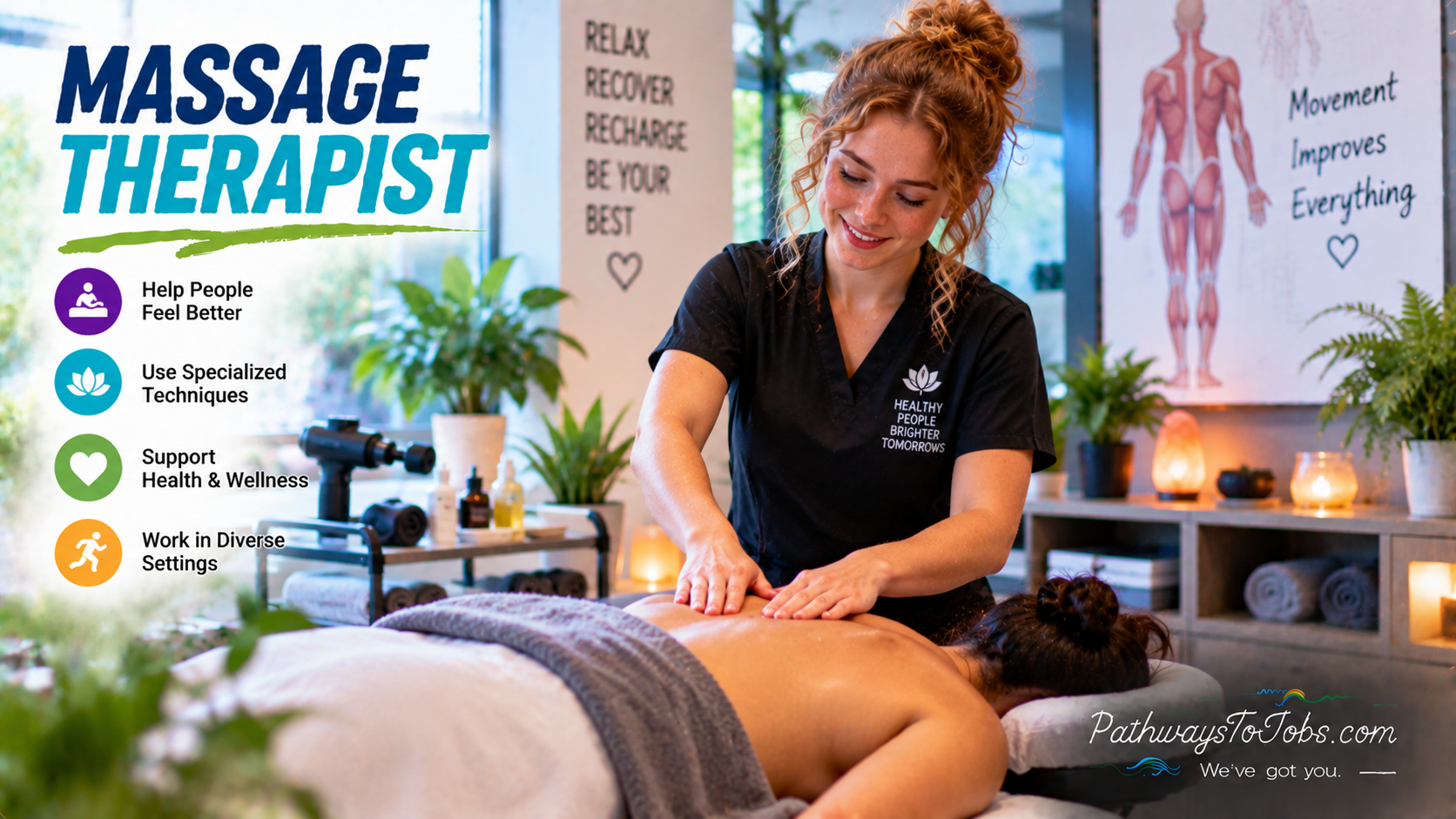
Massage therapists use hands-on techniques to work with muscles, soft tissues, and joints to help clients manage pain, reduce stress, improve movement, and support recovery. Many therapists now use digital booking systems, electronic client records, and other technology to manage their practices.
Education
A college diploma or professional massage therapy program is the usual starting point. Programs combine classroom learning with hands-on clinical experience in anatomy, physiology, massage techniques, ethics, and client care. Registration or licensing may be required, depending on where you work.
Work Environment
Massage therapists work in clinics, wellness centres, spas, fitness facilities, healthcare settings, and private practices. Many are self-employed, which can allow them to set their own schedules and build their own client base. The work involves being on your feet and using your hands and arms throughout the day.
Future Outlook
Demand for massage therapy is expected to remain strong as people seek services that support mobility, recovery, stress management, and overall wellness. Opportunities can grow as therapists build experience, develop specialized skills, or establish their own practice
Recommended High School Courses
- Biology
- Psychology
- Business
- Physical science
- Physical Education
- Health science
- Active Listening - Giving full attention to what other people are saying, taking time to understand the points being made, asking questions as appropriate, and not interrupting at inappropriate times.
- Complex Problem Solving - Identifying complex problems and reviewing related information to develop and evaluate options and implement solutions.
- Critical Thinking - Using logic and reasoning to identify the strengths and weaknesses of alternative solutions, conclusions or approaches to problems.
- Judgment and Decision Making - Considering the relative costs and benefits of potential actions to choose the most appropriate one.
- Reading Comprehension - Understanding written sentences and paragraphs in work related documents.
- Service Orientation - Actively looking for ways to help people.
- Social Perceptiveness - Being aware of others' reactions and understanding why they react as they do.
- Speaking - Talking to others to convey information effectively.
- Writing - Communicating effectively in writing as appropriate for the needs of the audience.
- Biology - Knowledge of plant and animal organisms, their tissues, cells, functions, interdependencies, and interactions with each other and the environment.
- Customer and Personal Service - Knowledge of principles and processes for providing customer and personal services. This includes customer needs assessment, meeting quality standards for services, and evaluation of customer satisfaction.
- English Language - Knowledge of the structure and content of the English language including the meaning and spelling of words, rules of composition, and grammar.
- Arm-Hand Steadiness - The ability to keep your hand and arm steady while moving your arm or while holding your arm and hand in one position.
- Deductive Reasoning - The ability to apply general rules to specific problems to produce answers that make sense.
- Dynamic Strength - The ability to exert muscle force repeatedly or continuously over time. This involves muscular endurance and resistance to muscle fatigue.
- Extent Flexibility - The ability to bend, stretch, twist, or reach with your body, arms, and/or legs.
- Finger Dexterity - The ability to make precisely coordinated movements of the fingers of one or both hands to grasp, manipulate, or assemble very small objects.
- Inductive Reasoning - The ability to combine pieces of information to form general rules or conclusions (includes finding a relationship among seemingly unrelated events).
- Manual Dexterity - The ability to quickly move your hand, your hand together with your arm, or your two hands to grasp, manipulate, or assemble objects.
- Multilimb Coordination - The ability to coordinate two or more limbs (for example, two arms, two legs, or one leg and one arm) while sitting, standing, or lying down. It does not involve performing the activities while the whole body is in motion.
- Near Vision - The ability to see details at close range (within a few feet of the observer).
- Oral Comprehension - The ability to listen to and understand information and ideas presented through spoken words and sentences.
- Oral Expression - The ability to communicate information and ideas in speaking so others will understand.
- Problem Sensitivity - The ability to tell when something is wrong or is likely to go wrong. It does not involve solving the problem, only recognizing there is a problem.
- Speech Clarity - The ability to speak clearly so others can understand you.
- Speech Recognition - The ability to identify and understand the speech of another person.
- Stamina - The ability to exert yourself physically over long periods of time without getting winded or out of breath.
- Static Strength - The ability to exert maximum muscle force to lift, push, pull, or carry objects.
- Trunk Strength - The ability to use your abdominal and lower back muscles to support part of the body repeatedly or continuously over time without 'giving out' or fatiguing.
- Written Comprehension - The ability to read and understand information and ideas presented in writing.
- Administer therapy treatments to patients using hands or physical treatment aids.
- Interview patients to gather medical information.
- Maintain medical records.
- Assess physical conditions of patients to aid in diagnosis or treatment.
- Teach medical procedures or medical equipment use to patients.
- Develop patient therapy programs.
- Confer with other professionals to plan patient care.
Schools


Potential Scholarships
Approx Salary Expectation



References
Trend Analysis - Explorer the Market, Labour Market Information, Government of Canada https://www.jobbank.gc.ca/trend-analysis.
O*NET OnLine, National Center for O*NET Development, https://www.onetonline.org/.