Sawmill Machine Operator
Sawmill Machine Operator
Career Overview
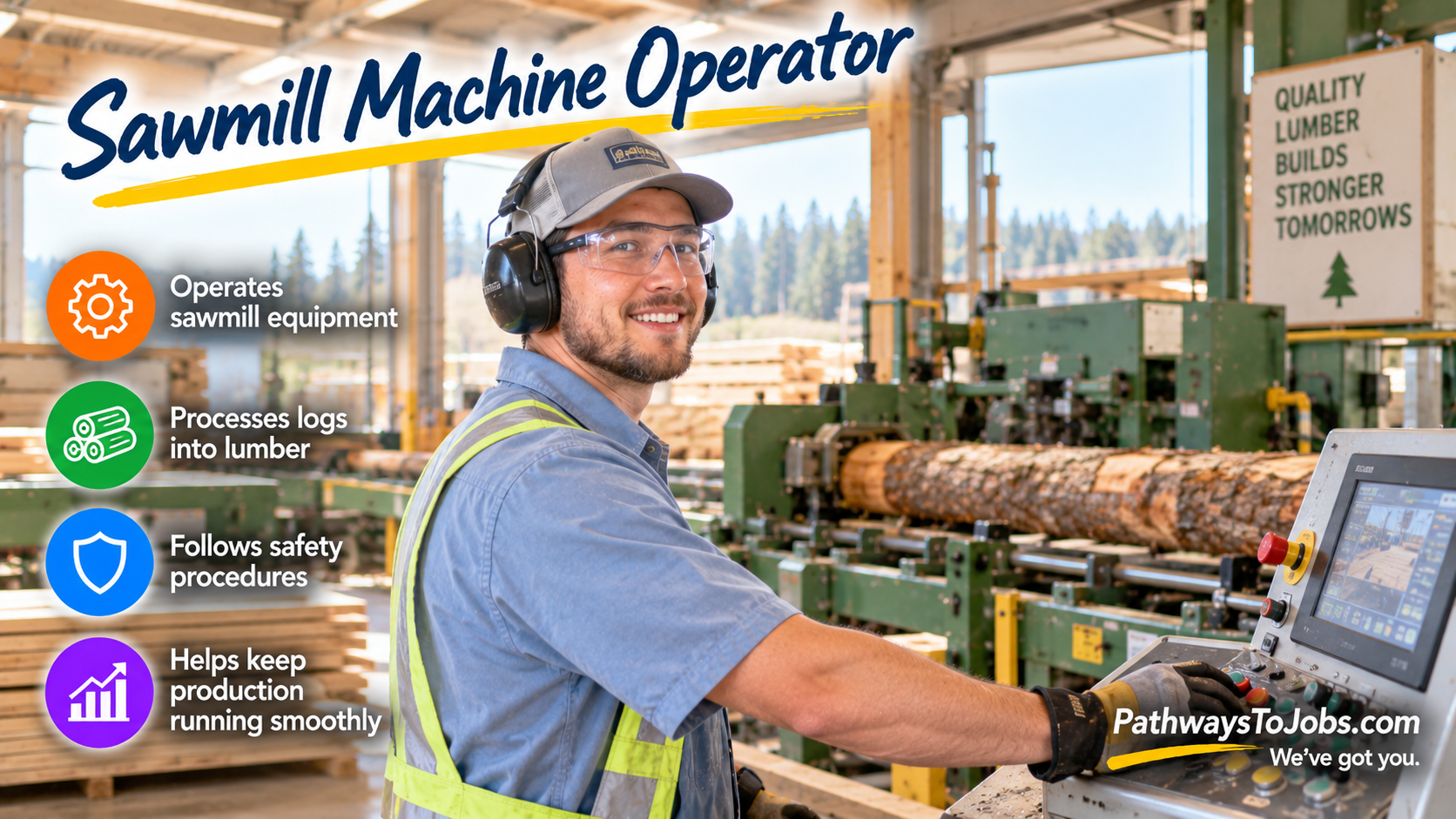
Sawmill machine operators run, monitor, and control machines that turn logs into lumber. They may cut, trim, and plane wood, or produce products such as shingles and shakes. Modern sawmills use automated equipment, computer controls, and other technology to improve production and safety.
Education
A high school diploma or equivalent is usually required. Some employers may prefer courses in wood processing, manufacturing, or industrial technology. Most workers receive several weeks of on-the-job training. Advanced positions, such as head sawyer or planer operator, usually require experience.
Work Environment
Sawmill machine operators usually work in sawmills or planing mills around large machinery, moving wood, noise, dust, and sawdust. Safety equipment, including hearing and eye protection, is important. The work is often full-time, and some mills operate shifts around the clock.
Future Outlook
Sawmills are becoming more automated, with computer-controlled equipment, sensors, and advanced machinery helping workers process wood more efficiently. Jobs will vary by region, and opportunities may be strongest where forestry and wood-product industries are active
Recommended High School Courses
- Mathematics
- Woodworking
- Computer Studies
- Manufacturing Technology
- Workplace Safety
- Critical Thinking - Using logic and reasoning to identify the strengths and weaknesses of alternative solutions, conclusions or approaches to problems.
- Monitoring - Monitoring/Assessing performance of yourself, other individuals, or organizations to make improvements or take corrective action.
- Operation and Control - Controlling operations of equipment or systems.
- Operation Monitoring - Watching gauges, dials, or other indicators to make sure a machine is working properly.
- Quality Control Analysis - Conducting tests and inspections of products, services, or processes to evaluate quality or performance.
- Troubleshooting - Determining causes of operating errors and deciding what to do about it.
- Mechanical - Knowledge of machines and tools, including their designs, uses, repair, and maintenance.
- Production and Processing - Knowledge of raw materials, production processes, quality control, costs, and other techniques for maximizing the effective manufacture and distribution of goods.
- Arm-Hand Steadiness - The ability to keep your hand and arm steady while moving your arm or while holding your arm and hand in one position.
- Control Precision - The ability to quickly and repeatedly adjust the controls of a machine or a vehicle to exact positions.
- Deductive Reasoning - The ability to apply general rules to specific problems to produce answers that make sense.
- Depth Perception - The ability to judge which of several objects is closer or farther away from you, or to judge the distance between you and an object.
- Far Vision - The ability to see details at a distance.
- Finger Dexterity - The ability to make precisely coordinated movements of the fingers of one or both hands to grasp, manipulate, or assemble very small objects.
- Inductive Reasoning - The ability to combine pieces of information to form general rules or conclusions (includes finding a relationship among seemingly unrelated events).
- Manual Dexterity - The ability to quickly move your hand, your hand together with your arm, or your two hands to grasp, manipulate, or assemble objects.
- Multilimb Coordination - The ability to coordinate two or more limbs (for example, two arms, two legs, or one leg and one arm) while sitting, standing, or lying down. It does not involve performing the activities while the whole body is in motion.
- Near Vision - The ability to see details at close range (within a few feet of the observer).
- Problem Sensitivity - The ability to tell when something is wrong or is likely to go wrong. It does not involve solving the problem, only recognizing there is a problem.
- Rate Control - The ability to time your movements or the movement of a piece of equipment in anticipation of changes in the speed and/or direction of a moving object or scene.
- Reaction Time - The ability to quickly respond (with the hand, finger, or foot) to a signal (sound, light, picture) when it appears.
- Selective Attention - The ability to concentrate on a task over a period of time without being distracted.
- Stamina - The ability to exert yourself physically over long periods of time without getting winded or out of breath.
- Static Strength - The ability to exert maximum muscle force to lift, push, pull, or carry objects.
- Trunk Strength - The ability to use your abdominal and lower back muscles to support part of the body repeatedly or continuously over time without 'giving out' or fatiguing.
- Measure dimensions of completed products or workpieces to verify conformance to specifications.
- Set equipment controls to meet cutting specifications.
- Mount attachments or tools onto production equipment.
- Set equipment guides, stops, spacers, or other fixtures.
- Inspect lumber or raw woodstock.
- Trim excess material from workpieces.
- Clear equipment jams.
- Monitor equipment operation to ensure proper functioning.
- Replace worn equipment components.
- Sharpen cutting or grinding tools.
- Operate cutting equipment.
- Maneuver workpieces in equipment during production.
- Count finished products or workpieces.
- Sort materials or products for processing, storing, shipping, or grading.
- Stack finished items for further processing or shipment.
- Mount materials or workpieces onto production equipment.
- Position raw materials on processing or production equipment.
- Measure materials to mark reference points, cutting lines, or other indicators.
- Operate woodworking equipment.
- Read work orders or other instructions to determine product specifications or materials requirements.
- Review blueprints or other instructions to determine operational methods or sequences.
- Select production equipment according to product specifications.
- Select production input materials.
- Study blueprints or other instructions to determine equipment setup requirements.
- Cut industrial materials in preparation for fabrication or processing.
- Shape metal workpieces with hammers or other small hand tools.
- Remove products or workpieces from production equipment.
- Clean production equipment.
- Lubricate production equipment.
- Dispose of trash or waste materials.
- Lift materials or workpieces using cranes or other lifting equipment.
Schools


Potential Scholarships
Approx Salary Expectation

References
WorkBC's Career Trek, http://www.careertrekbc.ca/.
Comparably, Inc., Comparably.com.
O*NET OnLine, National Center for O*NET Development, https://www.onetonline.org/.