Butcher
Butcher
Career Overview
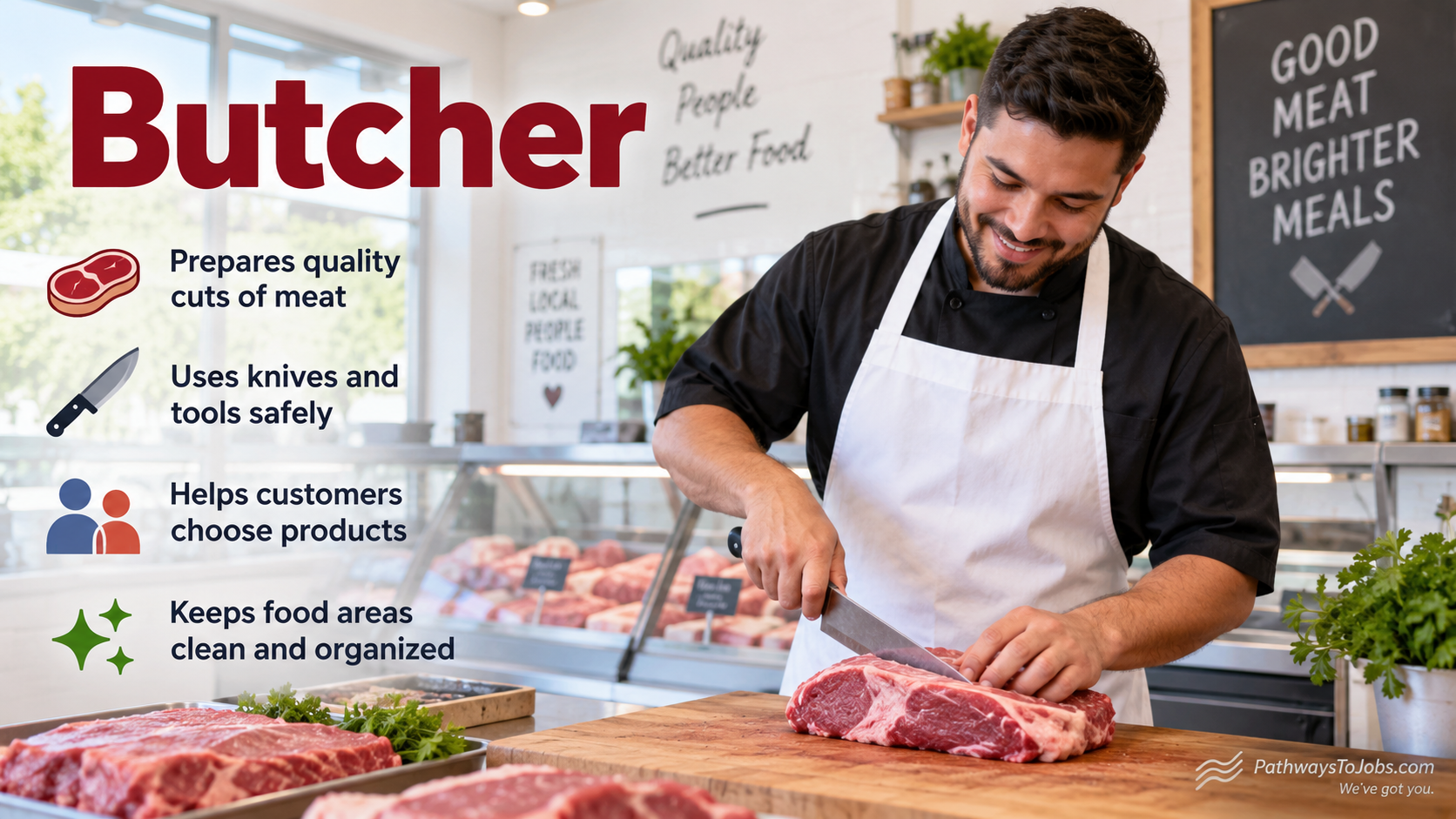
A Butcher cuts, trims, debones, grinds, packages, and prepares meat for customers in grocery stores, specialty meat shops, wholesale operations, and other food businesses. Modern butchers also work with precision cutting equipment, digital scales, inventory systems, and food-safety technology, while skilled workers may specialize in premium, custom, or specialty cuts.
Education
A high school diploma may be required, but formal post-secondary education is not usually necessary; many butchers learn through on-the-job training or an apprenticeship, and some complete a college or specialized butchery program. Training can take several months or longer as workers develop advanced cutting, deboning, food-safety, equipment, and customer-service skills.
Work Environment
Butchers typically work in grocery stores, specialty meat shops, wholesale operations, and food-processing facilities, often standing for long periods and working in cold environments around sharp knives, saws, grinders, and other equipment. Technology is changing the work, with automated cutting equipment, digital inventory systems, precision scales, and other food-processing technology handling more repetitive tasks while experienced butchers focus on quality, specialty cuts, safety, and customer service.
Future Outlook
There will continue to be jobs for skilled butchers, particularly in grocery stores, specialty meat shops, food production, and businesses that offer custom or premium cuts. Technology and automation are changing how meat is processed and packaged, but skilled workers are still needed for precision cutting, quality, food safety, specialty preparation, and customer service. Opportunities can be especially good for people who build strong skills and are willing to work in different food-production or retail settings.
Recommended High School Courses
- Math
- Business
- English
- Science
- Technology
- Food & Nutrition
- Active Listening - Giving full attention to what other people are saying, taking time to understand the points being made, asking questions as appropriate, and not interrupting at inappropriate times.
- Critical Thinking - Using logic and reasoning to identify the strengths and weaknesses of alternative solutions, conclusions or approaches to problems.
- Monitoring - Monitoring/Assessing performance of yourself, other individuals, or organizations to make improvements or take corrective action.
- Reading Comprehension - Understanding written sentences and paragraphs in work related documents.
- Service Orientation - Actively looking for ways to help people.
- Social Perceptiveness - Being aware of others' reactions and understanding why they react as they do.
- Speaking - Talking to others to convey information effectively.
- Time Management - Managing one's own time and the time of others.
- Customer and Personal Service - Knowledge of principles and processes for providing customer and personal services. This includes customer needs assessment, meeting quality standards for services, and evaluation of customer satisfaction.
- Food Production - Knowledge of techniques and equipment for planting, growing, and harvesting food products (both plant and animal) for consumption, including storage/handling techniques.
- Production and Processing - Knowledge of raw materials, production processes, quality control, costs, and other techniques for maximizing the effective manufacture and distribution of goods.
- Sales and Marketing - Knowledge of principles and methods for showing, promoting, and selling products or services. This includes marketing strategy and tactics, product demonstration, sales techniques, and sales control systems.
- Arm-Hand Steadiness - The ability to keep your hand and arm steady while moving your arm or while holding your arm and hand in one position.
- Category Flexibility - The ability to generate or use different sets of rules for combining or grouping things in different ways.
- Control Precision - The ability to quickly and repeatedly adjust the controls of a machine or a vehicle to exact positions.
- Finger Dexterity - The ability to make precisely coordinated movements of the fingers of one or both hands to grasp, manipulate, or assemble very small objects.
- Information Ordering - The ability to arrange things or actions in a certain order or pattern according to a specific rule or set of rules (e.g., patterns of numbers, letters, words, pictures, mathematical operations).
- Manual Dexterity - The ability to quickly move your hand, your hand together with your arm, or your two hands to grasp, manipulate, or assemble objects.
- Near Vision - The ability to see details at close range (within a few feet of the observer).
- Oral Comprehension - The ability to listen to and understand information and ideas presented through spoken words and sentences.
- Oral Expression - The ability to communicate information and ideas in speaking so others will understand.
- Problem Sensitivity - The ability to tell when something is wrong or is likely to go wrong. It does not involve solving the problem, only recognizing there is a problem.
- Selective Attention - The ability to concentrate on a task over a period of time without being distracted.
- Speech Clarity - The ability to speak clearly so others can understand you.
- Speech Recognition - The ability to identify and understand the speech of another person.
- Trunk Strength - The ability to use your abdominal and lower back muscles to support part of the body repeatedly or continuously over time without 'giving out' or fatiguing.
- Visual Color Discrimination - The ability to match or detect differences between colors, including shades of color and brightness.
- Prepare meat products for sale or consumption.
- Mark products, workpieces, or equipment with identifying information.
- Weigh finished products.
- Cut meat products.
- Inspect food products.
- Estimate material requirements for production.
- Order materials, supplies, or equipment.
- Record operational or production data.
- Direct operational or production activities.
- Load items into ovens or furnaces.
- Confer with customers or designers to determine order specifications.
Schools


Potential Scholarships
Approx Salary Expectation
Related Careers




References
Trend Analysis - Explorer the Market, Labour Market Information, Government of Canada https://www.jobbank.gc.ca/trend-analysis.
O*NET OnLine, National Center for O*NET Development, https://www.onetonline.org/.