Midwife
Midwife
Career Overview
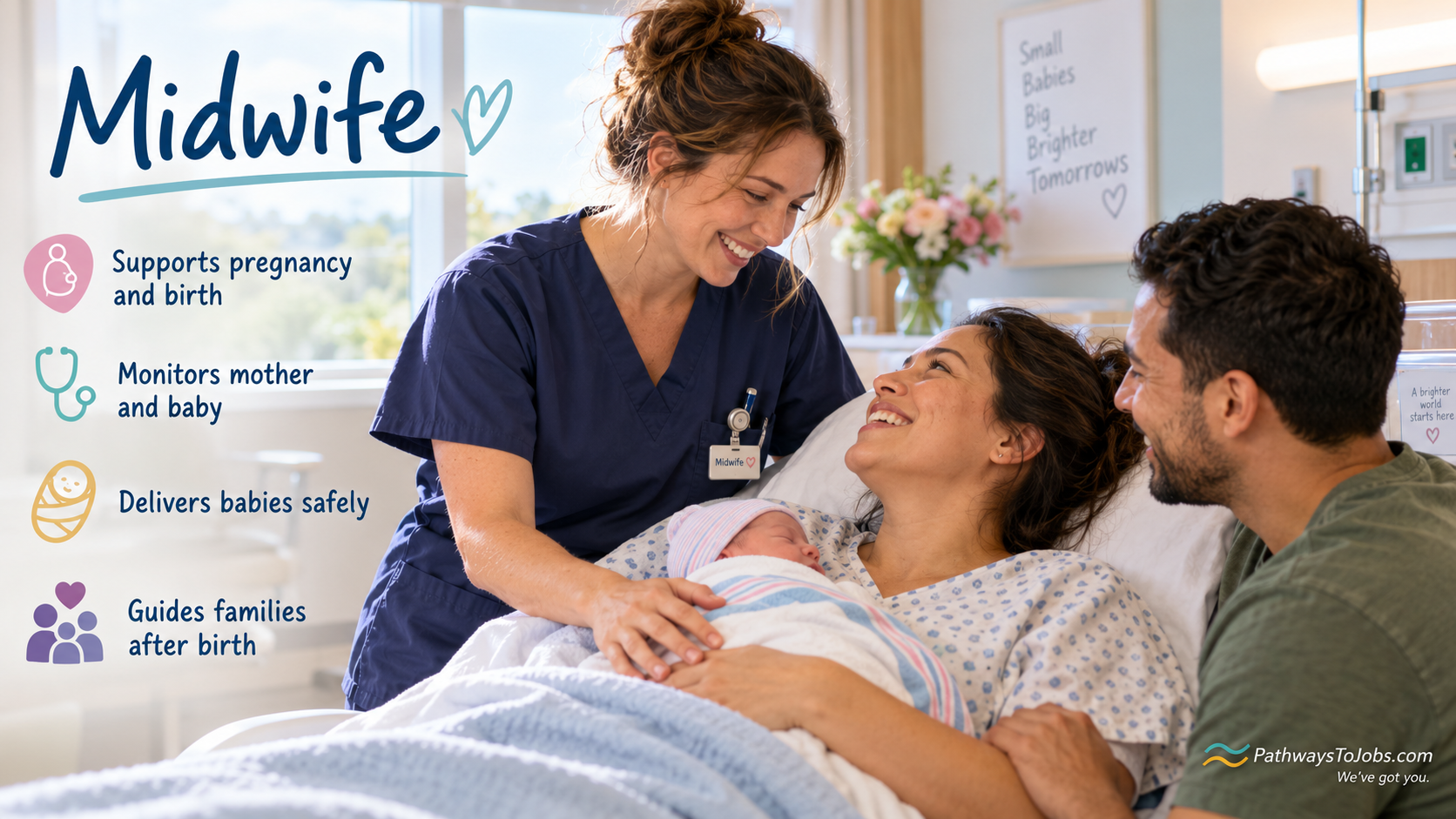
Midwives provide specialized care throughout pregnancy, labour, birth, and the postpartum period. They monitor the health of the parent and baby, provide education and guidance, support normal birth, identify potential complications, and coordinate with physicians and other healthcare professionals when additional care is needed.
Education
Education requirements depend on the country and the type of midwifery practice. In many systems, midwives complete a university-level midwifery program with substantial supervised clinical training. Some pathways require graduate-level education, particularly where midwifery is practiced as an advanced nursing profession. Professional registration or licensing is required to practise independently.
Work Environment
Midwives work in hospitals, birth centres, clinics, community health settings, and sometimes clients’ homes. The work is highly hands-on and involves close relationships with families. Midwives may work as part of a larger healthcare team and often have schedules that include evenings, nights, weekends, holidays, or on-call periods.
Future Outlook
The outlook is positive, with continued demand for skilled maternity and reproductive healthcare professionals. Growing healthcare needs, access to maternity services, and the continued role of midwives in supporting pregnancy, birth, and postpartum care are expected to create ongoing opportunities. The field is also evolving through improved digital health tools, clinical technology, and collaborative models of care.
Recommended High School Courses
- Chemistry
- Biology
- Psychology
- Communication
- Anatomy
- Health science
- Active Learning - Understanding the implications of new information for both current and future problem-solving and decision-making.
- Active Listening - Giving full attention to what other people are saying, taking time to understand the points being made, asking questions as appropriate, and not interrupting at inappropriate times.
- Complex Problem Solving - Identifying complex problems and reviewing related information to develop and evaluate options and implement solutions.
- Coordination - Adjusting actions in relation to others' actions.
- Critical Thinking - Using logic and reasoning to identify the strengths and weaknesses of alternative solutions, conclusions or approaches to problems.
- Instructing - Teaching others how to do something.
- Judgment and Decision Making - Considering the relative costs and benefits of potential actions to choose the most appropriate one.
- Learning Strategies - Selecting and using training/instructional methods and procedures appropriate for the situation when learning or teaching new things.
- Monitoring - Monitoring/Assessing performance of yourself, other individuals, or organizations to make improvements or take corrective action.
- Reading Comprehension - Understanding written sentences and paragraphs in work related documents.
- Service Orientation - Actively looking for ways to help people.
- Social Perceptiveness - Being aware of others' reactions and understanding why they react as they do.
- Speaking - Talking to others to convey information effectively.
- Time Management - Managing one's own time and the time of others.
- Writing - Communicating effectively in writing as appropriate for the needs of the audience.
- Administration and Management - Knowledge of business and management principles involved in strategic planning, resource allocation, human resources modeling, leadership technique, production methods, and coordination of people and resources.
- Biology - Knowledge of plant and animal organisms, their tissues, cells, functions, interdependencies, and interactions with each other and the environment.
- Clerical - Knowledge of administrative and clerical procedures and systems such as word processing, managing files and records, stenography and transcription, designing forms, and other office procedures and terminology.
- Customer and Personal Service - Knowledge of principles and processes for providing customer and personal services. This includes customer needs assessment, meeting quality standards for services, and evaluation of customer satisfaction.
- Education and Training - Knowledge of principles and methods for curriculum and training design, teaching and instruction for individuals and groups, and the measurement of training effects.
- English Language - Knowledge of the structure and content of the English language including the meaning and spelling of words, rules of composition, and grammar.
- Law and Government - Knowledge of laws, legal codes, court procedures, precedents, government regulations, executive orders, agency rules, and the democratic political process.
- Medicine and Dentistry - Knowledge of the information and techniques needed to diagnose and treat human injuries, diseases, and deformities. This includes symptoms, treatment alternatives, drug properties and interactions, and preventive health-care measures.
- Psychology - Knowledge of human behavior and performance; individual differences in ability, personality, and interests; learning and motivation; psychological research methods; and the assessment and treatment of behavioral and affective disorders.
- Sociology and Anthropology - Knowledge of group behavior and dynamics, societal trends and influences, human migrations, ethnicity, cultures and their history and origins.
- Therapy and Counseling - Knowledge of principles, methods, and procedures for diagnosis, treatment, and rehabilitation of physical and mental dysfunctions, and for career counseling and guidance.
- Arm-Hand Steadiness - The ability to keep your hand and arm steady while moving your arm or while holding your arm and hand in one position.
- Category Flexibility - The ability to generate or use different sets of rules for combining or grouping things in different ways.
- Deductive Reasoning - The ability to apply general rules to specific problems to produce answers that make sense.
- Flexibility of Closure - The ability to identify or detect a known pattern (a figure, object, word, or sound) that is hidden in other distracting material.
- Inductive Reasoning - The ability to combine pieces of information to form general rules or conclusions (includes finding a relationship among seemingly unrelated events).
- Information Ordering - The ability to arrange things or actions in a certain order or pattern according to a specific rule or set of rules (e.g., patterns of numbers, letters, words, pictures, mathematical operations).
- Near Vision - The ability to see details at close range (within a few feet of the observer).
- Oral Comprehension - The ability to listen to and understand information and ideas presented through spoken words and sentences.
- Oral Expression - The ability to communicate information and ideas in speaking so others will understand.
- Perceptual Speed - The ability to quickly and accurately compare similarities and differences among sets of letters, numbers, objects, pictures, or patterns. The things to be compared may be presented at the same time or one after the other. This ability also includes comparing a presented object with a remembered object.
- Problem Sensitivity - The ability to tell when something is wrong or is likely to go wrong. It does not involve solving the problem, only recognizing there is a problem.
- Selective Attention - The ability to concentrate on a task over a period of time without being distracted.
- Speech Clarity - The ability to speak clearly so others can understand you.
- Speech Recognition - The ability to identify and understand the speech of another person.
- Written Comprehension - The ability to read and understand information and ideas presented in writing.
- Written Expression - The ability to communicate information and ideas in writing so others will understand.
- Examine patients to assess general physical condition.
- Monitor patient conditions during treatments, procedures, or activities.
- Care for women during pregnancy and childbirth.
- Diagnose medical conditions.
- Measure the physical or physiological attributes of patients.
- Develop medical treatment plans.
- Treat medical emergencies.
- Refer patients to other healthcare practitioners or health resources.
- Evaluate patient functioning, capabilities, or health.
- Record patient medical histories.
- Provide health and wellness advice to patients, program participants, or caregivers.
- Analyze patient data to determine patient needs or treatment goals.
- Collect medical information from patients, family members, or other medical professionals.
- Operate on patients to treat conditions.
- Communicate detailed medical information to patients or family members.
- Analyze test data or images to inform diagnosis or treatment.
- Collaborate with healthcare professionals to plan or provide treatment.
- Position patients for treatment or examination.
- Prepare medical supplies or equipment for use.
- Prepare official health documents or records.
- Test biological specimens to gather information about patient conditions.
- Collect biological specimens from patients.
- Treat patients using alternative medical procedures.
- Communicate health and wellness information to the public.
- Analyze quantitative data to determine effectiveness of treatments or therapies.
- Conduct research to increase knowledge about medical issues.
Schools


Potential Scholarships
Approx Salary Expectation


References
Trend Analysis - Explorer the Market, Labour Market Information, Government of Canada https://www.jobbank.gc.ca/trend-analysis.
O*NET OnLine, National Center for O*NET Development, https://www.onetonline.org/.