Occupational Therapist
Occupational Therapist
Career Overview
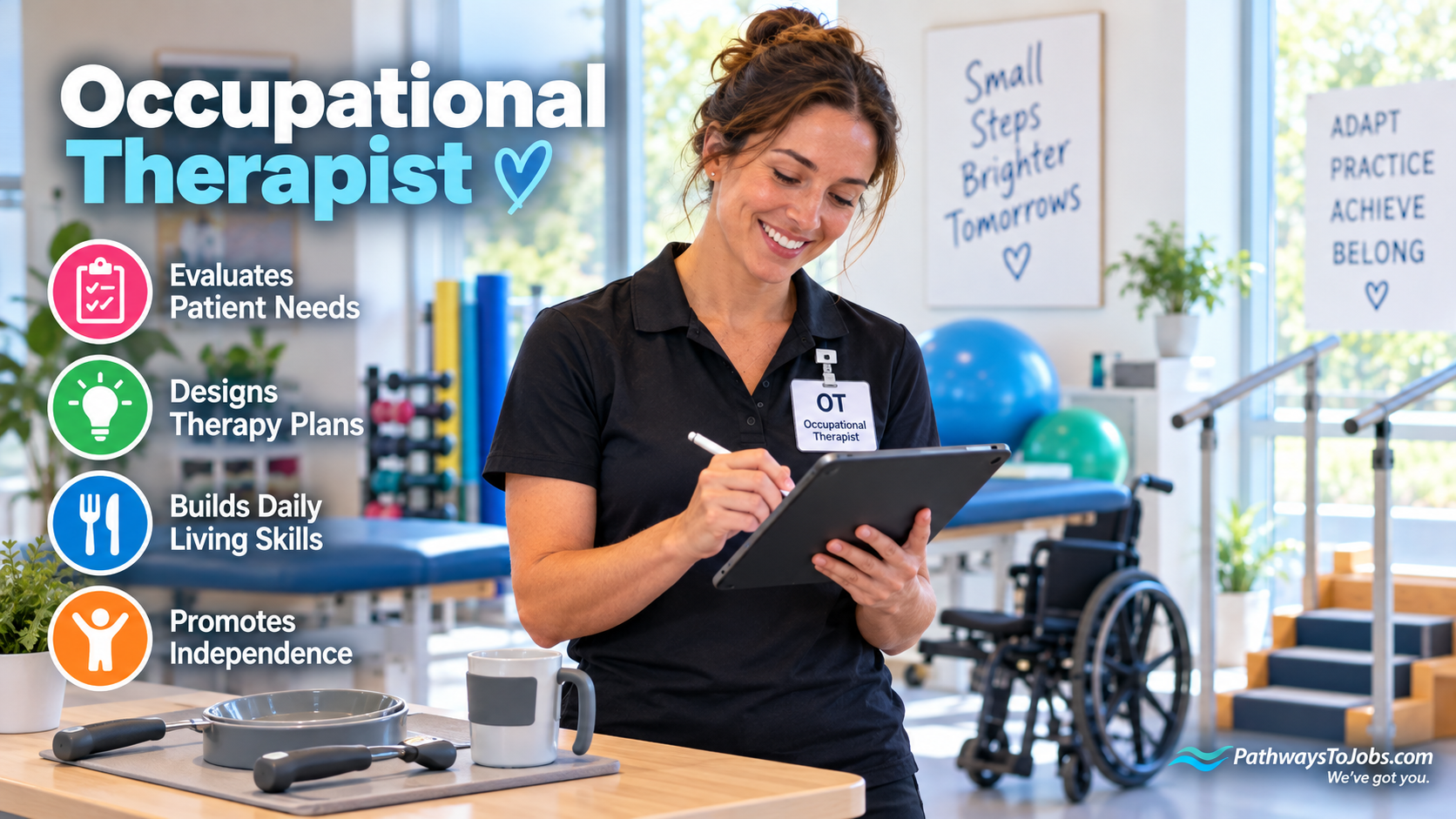
Occupational therapists help people develop, recover, improve, and maintain the skills needed for everyday living and working. They evaluate a person’s abilities, create individualized treatment plans, teach practical activities and exercises, and may recommend adaptive equipment or changes to a home, school, or workplace.
Education
Occupational therapists typically need a master’s degree in occupational therapy. Programs generally require a bachelor’s degree for admission and include coursework in areas such as anatomy, neuroscience, and kinesiology, along with supervised clinical fieldwork. Professional licensing or registration is also required to practise.
Work Environment
Occupational therapists work in hospitals, outpatient clinics, schools, rehabilitation settings, nursing facilities, and clients’ homes. The work can involve spending considerable time on their feet and sometimes lifting or moving clients or equipment. Full-time work is common, although part-time schedules are also available.
Future Outlook
Demand for occupational therapy is expected to remain strong as populations age and more people require support with independence, rehabilitation, disabilities, and everyday activities. Occupational therapy also continues to play an important role in supporting children and adults with developmental, neurological, and other conditions. Current employment projections indicate faster-than-average growth for the profession.
Recommended High School Courses
- Chemistry
- Biology
- Psychology
- Math
- Communication
- Anatomy
- Health science
- Active Learning - Understanding the implications of new information for both current and future problem-solving and decision-making.
- Active Listening - Giving full attention to what other people are saying, taking time to understand the points being made, asking questions as appropriate, and not interrupting at inappropriate times.
- Complex Problem Solving - Identifying complex problems and reviewing related information to develop and evaluate options and implement solutions.
- Coordination - Adjusting actions in relation to others' actions.
- Critical Thinking - Using logic and reasoning to identify the strengths and weaknesses of alternative solutions, conclusions or approaches to problems.
- Instructing - Teaching others how to do something.
- Judgment and Decision Making - Considering the relative costs and benefits of potential actions to choose the most appropriate one.
- Learning Strategies - Selecting and using training/instructional methods and procedures appropriate for the situation when learning or teaching new things.
- Management of Personnel Resources - Motivating, developing, and directing people as they work, identifying the best people for the job.
- Monitoring - Monitoring/Assessing performance of yourself, other individuals, or organizations to make improvements or take corrective action.
- Negotiation - Bringing others together and trying to reconcile differences.
- Operations Analysis - Analyzing needs and product requirements to create a design.
- Persuasion - Persuading others to change their minds or behavior.
- Reading Comprehension - Understanding written sentences and paragraphs in work related documents.
- Service Orientation - Actively looking for ways to help people.
- Social Perceptiveness - Being aware of others' reactions and understanding why they react as they do.
- Speaking - Talking to others to convey information effectively.
- Systems Analysis - Determining how a system should work and how changes in conditions, operations, and the environment will affect outcomes.
- Systems Evaluation - Identifying measures or indicators of system performance and the actions needed to improve or correct performance, relative to the goals of the system.
- Time Management - Managing one's own time and the time of others.
- Writing - Communicating effectively in writing as appropriate for the needs of the audience.
- Biology - Knowledge of plant and animal organisms, their tissues, cells, functions, interdependencies, and interactions with each other and the environment.
- Customer and Personal Service - Knowledge of principles and processes for providing customer and personal services. This includes customer needs assessment, meeting quality standards for services, and evaluation of customer satisfaction.
- Education and Training - Knowledge of principles and methods for curriculum and training design, teaching and instruction for individuals and groups, and the measurement of training effects.
- English Language - Knowledge of the structure and content of the English language including the meaning and spelling of words, rules of composition, and grammar.
- Medicine and Dentistry - Knowledge of the information and techniques needed to diagnose and treat human injuries, diseases, and deformities. This includes symptoms, treatment alternatives, drug properties and interactions, and preventive health-care measures.
- Psychology - Knowledge of human behavior and performance; individual differences in ability, personality, and interests; learning and motivation; psychological research methods; and the assessment and treatment of behavioral and affective disorders.
- Sociology and Anthropology - Knowledge of group behavior and dynamics, societal trends and influences, human migrations, ethnicity, cultures and their history and origins.
- Therapy and Counseling - Knowledge of principles, methods, and procedures for diagnosis, treatment, and rehabilitation of physical and mental dysfunctions, and for career counseling and guidance.
- Arm-Hand Steadiness - The ability to keep your hand and arm steady while moving your arm or while holding your arm and hand in one position.
- Category Flexibility - The ability to generate or use different sets of rules for combining or grouping things in different ways.
- Deductive Reasoning - The ability to apply general rules to specific problems to produce answers that make sense.
- Finger Dexterity - The ability to make precisely coordinated movements of the fingers of one or both hands to grasp, manipulate, or assemble very small objects.
- Flexibility of Closure - The ability to identify or detect a known pattern (a figure, object, word, or sound) that is hidden in other distracting material.
- Fluency of Ideas - The ability to come up with a number of ideas about a topic (the number of ideas is important, not their quality, correctness, or creativity).
- Inductive Reasoning - The ability to combine pieces of information to form general rules or conclusions (includes finding a relationship among seemingly unrelated events).
- Information Ordering - The ability to arrange things or actions in a certain order or pattern according to a specific rule or set of rules (e.g., patterns of numbers, letters, words, pictures, mathematical operations).
- Near Vision - The ability to see details at close range (within a few feet of the observer).
- Oral Comprehension - The ability to listen to and understand information and ideas presented through spoken words and sentences.
- Oral Expression - The ability to communicate information and ideas in speaking so others will understand.
- Originality - The ability to come up with unusual or clever ideas about a given topic or situation, or to develop creative ways to solve a problem.
- Problem Sensitivity - The ability to tell when something is wrong or is likely to go wrong. It does not involve solving the problem, only recognizing there is a problem.
- Selective Attention - The ability to concentrate on a task over a period of time without being distracted.
- Speech Clarity - The ability to speak clearly so others can understand you.
- Speech Recognition - The ability to identify and understand the speech of another person.
- Written Comprehension - The ability to read and understand information and ideas presented in writing.
- Written Expression - The ability to communicate information and ideas in writing so others will understand.
- Record patient medical histories.
- Analyze patient data to determine patient needs or treatment goals.
- Evaluate patient functioning, capabilities, or health.
- Train caregivers or other non-medical personnel.
- Monitor patient progress or responses to treatments.
- Prepare reports summarizing patient diagnostic or care activities.
- Design public or employee health programs.
- Direct healthcare delivery programs.
- Develop treatment plans that use non-medical therapies.
- Provide health and wellness advice to patients, program participants, or caregivers.
- Design medical devices or appliances.
- Fabricate medical devices.
- Collaborate with healthcare professionals to plan or provide treatment.
- Clean medical equipment or facilities.
- Prepare medical supplies or equipment for use.
- Supervise patient care personnel.
- Train medical providers.
- Conduct research to increase knowledge about medical issues.
- Advise communities or institutions regarding health or safety issues.
- Encourage patients or clients to develop life skills.
Schools


Potential Scholarships
Approx Salary Expectation
Related Careers

References
Trend Analysis - Explorer the Market, Labour Market Information, Government of Canada https://www.jobbank.gc.ca/trend-analysis.
O*NET OnLine, National Center for O*NET Development, https://www.onetonline.org/.