Automotive Body Technician
Automotive Body Technician
Career Overview
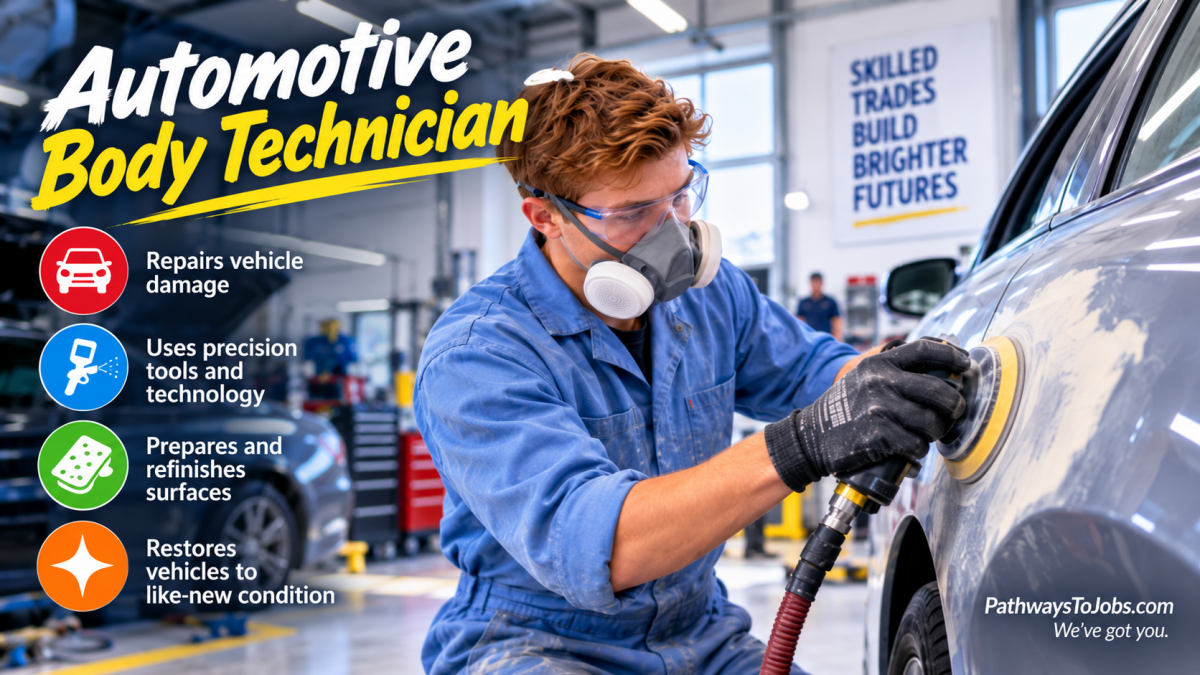
Automotive body technicians repair and restore vehicles after collisions, from dents and cosmetic damage to major structural repairs. Today's technicians work with advanced materials, computerized measuring systems, electronics, sensors, cameras, and ADAS technology to return vehicles to safe, manufacturer-approved condition.
Education
A high school diploma is a common starting point, followed by an apprenticeship or post-secondary collision-repair program. Training covers areas such as structural repair, welding, refinishing, electronics, estimating, and manufacturer repair procedures, with ongoing training needed as vehicle technology changes. * Red Seal Eligible in Canada
Work Environment
Automotive body technicians work mainly in collision repair centres, dealerships, and body shops. The work is hands-on and can involve noise, dust, paint products, lifting, bending, and working in tight spaces, while modern shops also rely on computerized measuring, diagnostic equipment, digital repair information, and specialized tools.
Future Outlook
Vehicles are becoming more computerized, connected, electrified, and equipped with advanced safety systems, so collision technicians need more than traditional body-repair skills. Knowledge of sensors, cameras, ADAS, advanced materials, electronic systems, digital measuring, and manufacturer repair procedures is becoming increasingly important. Employment is projected to grow slowly, but thousands of openings are expected as experienced technicians retire or leave the occupation.
Recommended High School Courses
- Electronics
- Communication
- Automotive Repair
- Computer Studies
- Art & Design
- Active Listening - Giving full attention to what other people are saying, taking time to understand the points being made, asking questions as appropriate, and not interrupting at inappropriate times.
- Critical Thinking - Using logic and reasoning to identify the strengths and weaknesses of alternative solutions, conclusions or approaches to problems.
- Monitoring - Monitoring/Assessing performance of yourself, other individuals, or organizations to make improvements or take corrective action.
- Operation Monitoring - Watching gauges, dials, or other indicators to make sure a machine is working properly.
- Quality Control Analysis - Conducting tests and inspections of products, services, or processes to evaluate quality or performance.
- Repairing - Repairing machines or systems using the needed tools.
- Speaking - Talking to others to convey information effectively.
- Time Management - Managing one's own time and the time of others.
- Troubleshooting - Determining causes of operating errors and deciding what to do about it.
- Customer and Personal Service - Knowledge of principles and processes for providing customer and personal services. This includes customer needs assessment, meeting quality standards for services, and evaluation of customer satisfaction.
- Mathematics - Knowledge of arithmetic, algebra, geometry, calculus, statistics, and their applications.
- Mechanical - Knowledge of machines and tools, including their designs, uses, repair, and maintenance.
- Production and Processing - Knowledge of raw materials, production processes, quality control, costs, and other techniques for maximizing the effective manufacture and distribution of goods.
- Arm-Hand Steadiness - The ability to keep your hand and arm steady while moving your arm or while holding your arm and hand in one position.
- Auditory Attention - The ability to focus on a single source of sound in the presence of other distracting sounds.
- Category Flexibility - The ability to generate or use different sets of rules for combining or grouping things in different ways.
- Control Precision - The ability to quickly and repeatedly adjust the controls of a machine or a vehicle to exact positions.
- Extent Flexibility - The ability to bend, stretch, twist, or reach with your body, arms, and/or legs.
- Finger Dexterity - The ability to make precisely coordinated movements of the fingers of one or both hands to grasp, manipulate, or assemble very small objects.
- Flexibility of Closure - The ability to identify or detect a known pattern (a figure, object, word, or sound) that is hidden in other distracting material.
- Information Ordering - The ability to arrange things or actions in a certain order or pattern according to a specific rule or set of rules (e.g., patterns of numbers, letters, words, pictures, mathematical operations).
- Manual Dexterity - The ability to quickly move your hand, your hand together with your arm, or your two hands to grasp, manipulate, or assemble objects.
- Multilimb Coordination - The ability to coordinate two or more limbs (for example, two arms, two legs, or one leg and one arm) while sitting, standing, or lying down. It does not involve performing the activities while the whole body is in motion.
- Near Vision - The ability to see details at close range (within a few feet of the observer).
- Oral Comprehension - The ability to listen to and understand information and ideas presented through spoken words and sentences.
- Oral Expression - The ability to communicate information and ideas in speaking so others will understand.
- Problem Sensitivity - The ability to tell when something is wrong or is likely to go wrong. It does not involve solving the problem, only recognizing there is a problem.
- Selective Attention - The ability to concentrate on a task over a period of time without being distracted.
- Speech Clarity - The ability to speak clearly so others can understand you.
- Speech Recognition - The ability to identify and understand the speech of another person.
- Static Strength - The ability to exert maximum muscle force to lift, push, pull, or carry objects.
- Trunk Strength - The ability to use your abdominal and lower back muscles to support part of the body repeatedly or continuously over time without 'giving out' or fatiguing.
- Visual Color Discrimination - The ability to match or detect differences between colors, including shades of color and brightness.
- Visualization - The ability to imagine how something will look after it is moved around or when its parts are moved or rearranged.
- Written Comprehension - The ability to read and understand information and ideas presented in writing.
- Smooth surfaces of objects or equipment.
- Inspect completed work to ensure proper functioning.
- Install vehicle parts or accessories.
- Operate welding equipment.
- Paint surfaces or equipment.
- Apply protective coverings to objects or surfaces near work areas.
- Cut materials according to specifications or needs.
- Remove dents from equipment, materials, tools or structures.
- Read work orders or descriptions of problems to determine repairs or modifications needed.
- Plan work procedures.
- Remove parts or components from vehicles.
- Disassemble equipment for maintenance or repair.
- Install machine or equipment replacement parts.
- Prepare compounds or solutions to be used for repairs.
- Adjust vehicle components according to specifications.
- Replace vehicle glass.
- Clean work areas.
- Confer with customers or users to assess problems.
- Measure distances or dimensions.
Schools


Potential Scholarships
Approx Salary Expectation


References
Trend Analysis - Explorer the Market, Labour Market Information, Government of Canada https://www.jobbank.gc.ca/trend-analysis.
O*NET OnLine, National Center for O*NET Development, https://www.onetonline.org/.