Deckhand
Deckhand
Career Overview
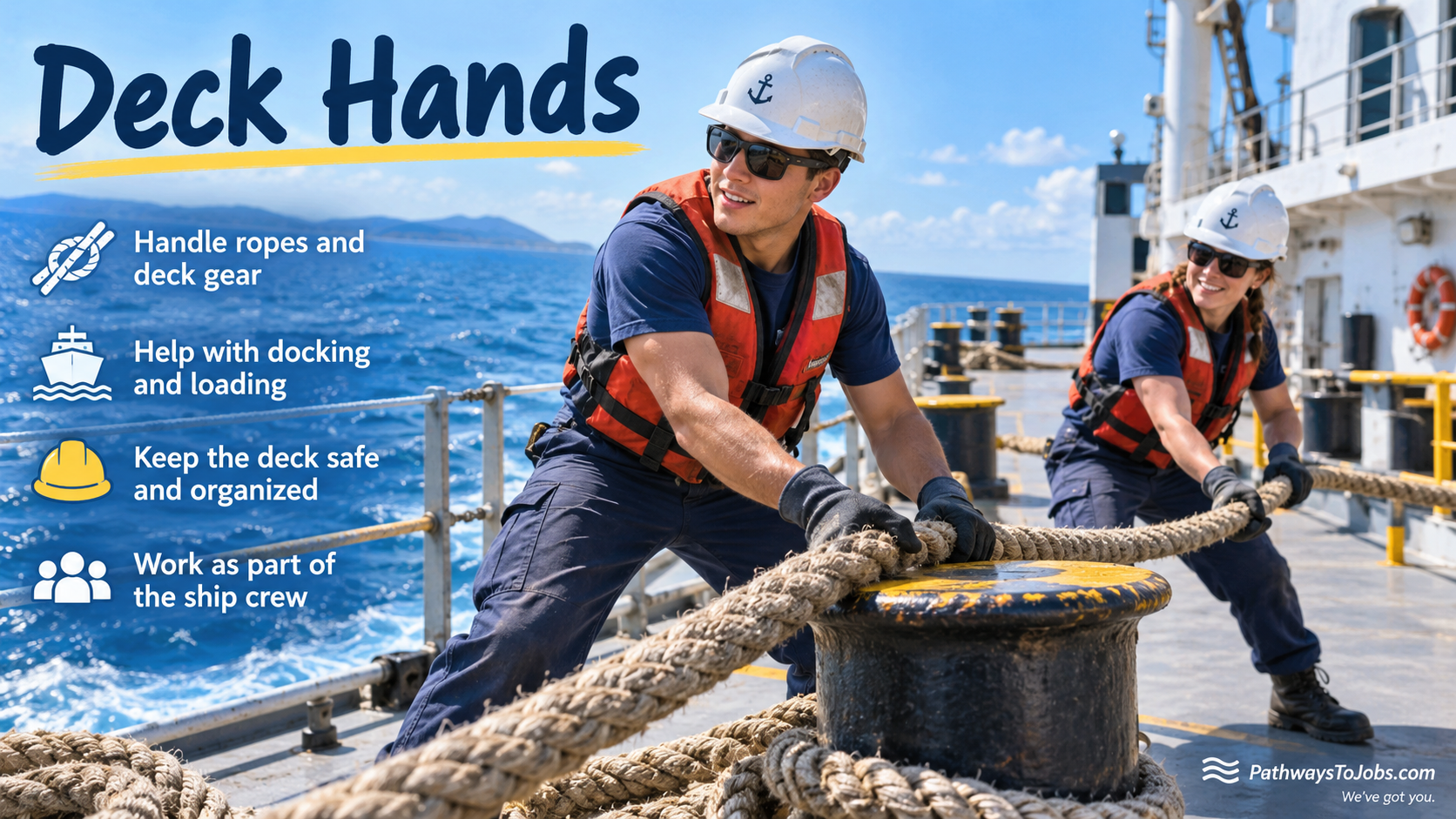
Deckhands are part of a ship’s working crew. They help operate and maintain the vessel, handle ropes and equipment, secure cargo, assist with loading and unloading, keep the deck in good condition, and help the ship’s officers with daily operations. Deckhands can work on cargo ships, ferries, fishing vessels, research vessels, and other watercraft.
Education
A college or university degree is not usually required to start as a deckhand. Employers typically provide on-the-job training, and additional marine-safety training or certificates may be required depending on the vessel and type of work. Some deckhand positions also require specific maritime credentials or licenses.
Work Environment
Deckhands work aboard ships and other vessels, often spending extended periods away from home. The job is hands-on and can involve climbing, lifting, maintaining equipment, standing watch, and working outdoors in changing weather. Schedules can vary widely—some crews work regular shifts, while others may spend weeks or months aboard a vessel
Future Outlook
Water transportation will continue to need skilled crew members to move people and goods, maintain vessels, and keep marine operations running safely. Opportunities can vary with shipping, commercial transportation, fishing, tourism, and other marine industries. Technology is also changing modern vessels, with more automated equipment, digital navigation, monitoring systems, and advanced onboard technology. Experience and additional training can open pathways to more specialized or senior maritime positions.
Recommended High School Courses
- Math
- Communication
- Physical Education
- Geography
- Marine emergency duties
- Active Listening - Giving full attention to what other people are saying, taking time to understand the points being made, asking questions as appropriate, and not interrupting at inappropriate times.
- Critical Thinking - Using logic and reasoning to identify the strengths and weaknesses of alternative solutions, conclusions or approaches to problems.
- Judgment and Decision Making - Considering the relative costs and benefits of potential actions to choose the most appropriate one.
- Operation and Control - Controlling operations of equipment or systems.
- Operation Monitoring - Watching gauges, dials, or other indicators to make sure a machine is working properly.
- Speaking - Talking to others to convey information effectively.
- Food Production - Knowledge of techniques and equipment for planting, growing, and harvesting food products (both plant and animal) for consumption, including storage/handling techniques.
- Geography - Knowledge of principles and methods for describing the features of land, sea, and air masses, including their physical characteristics, locations, interrelationships, and distribution of plant, animal, and human life.
- Mechanical - Knowledge of machines and tools, including their designs, uses, repair, and maintenance.
- Production and Processing - Knowledge of raw materials, production processes, quality control, costs, and other techniques for maximizing the effective manufacture and distribution of goods.
- Transportation - Knowledge of principles and methods for moving people or goods by air, rail, sea, or road, including the relative costs and benefits.
- Arm-Hand Steadiness - The ability to keep your hand and arm steady while moving your arm or while holding your arm and hand in one position.
- Category Flexibility - The ability to generate or use different sets of rules for combining or grouping things in different ways.
- Control Precision - The ability to quickly and repeatedly adjust the controls of a machine or a vehicle to exact positions.
- Deductive Reasoning - The ability to apply general rules to specific problems to produce answers that make sense.
- Depth Perception - The ability to judge which of several objects is closer or farther away from you, or to judge the distance between you and an object.
- Dynamic Strength - The ability to exert muscle force repeatedly or continuously over time. This involves muscular endurance and resistance to muscle fatigue.
- Extent Flexibility - The ability to bend, stretch, twist, or reach with your body, arms, and/or legs.
- Far Vision - The ability to see details at a distance.
- Finger Dexterity - The ability to make precisely coordinated movements of the fingers of one or both hands to grasp, manipulate, or assemble very small objects.
- Gross Body Equilibrium - The ability to keep or regain your body balance or stay upright when in an unstable position.
- Information Ordering - The ability to arrange things or actions in a certain order or pattern according to a specific rule or set of rules (e.g., patterns of numbers, letters, words, pictures, mathematical operations).
- Manual Dexterity - The ability to quickly move your hand, your hand together with your arm, or your two hands to grasp, manipulate, or assemble objects.
- Multilimb Coordination - The ability to coordinate two or more limbs (for example, two arms, two legs, or one leg and one arm) while sitting, standing, or lying down. It does not involve performing the activities while the whole body is in motion.
- Near Vision - The ability to see details at close range (within a few feet of the observer).
- Oral Comprehension - The ability to listen to and understand information and ideas presented through spoken words and sentences.
- Oral Expression - The ability to communicate information and ideas in speaking so others will understand.
- Rate Control - The ability to time your movements or the movement of a piece of equipment in anticipation of changes in the speed and/or direction of a moving object or scene.
- Reaction Time - The ability to quickly respond (with the hand, finger, or foot) to a signal (sound, light, picture) when it appears.
- Selective Attention - The ability to concentrate on a task over a period of time without being distracted.
- Speech Clarity - The ability to speak clearly so others can understand you.
- Speech Recognition - The ability to identify and understand the speech of another person.
- Static Strength - The ability to exert maximum muscle force to lift, push, pull, or carry objects.
- Trunk Strength - The ability to use your abdominal and lower back muscles to support part of the body repeatedly or continuously over time without 'giving out' or fatiguing.
- Navigate water vessels.
- Position animal trapping or capture equipment.
- Maintain forestry, hunting, or agricultural equipment.
- Capture or kill animals.
- Locate animals for fishing or hunting purposes.
- Package agricultural products for shipment or further processing.
- Sort forestry or agricultural materials.
- Communicate with other workers to coordinate activities.
- Direct activities of agricultural, forestry, or fishery employees.
- Hire farming, fishing or forestry workers.
- Maintain inventories of materials, equipment, or products.
- Attach equipment extensions or accessories.
- Plan trapping or hunting activities.
- Transport animals, crops, or equipment.
- Sell agricultural products.
- Clean equipment or facilities.
- Monitor financial activities.
- Maintain operational records.
- Load agricultural or forestry products for shipment.
- Estimate labor or resource requirements for forestry, fishing, or agricultural operations.
- Promote agricultural or hunting activities.
- Treat animal injuries or illnesses.
Potential Scholarships
Approx Salary Expectation




References
Trend Analysis - Explorer the Market, Labour Market Information, Government of Canada https://www.jobbank.gc.ca/trend-analysis.
O*NET OnLine, National Center for O*NET Development, https://www.onetonline.org/.