Data Engineer
Data Engineer
Career Overview
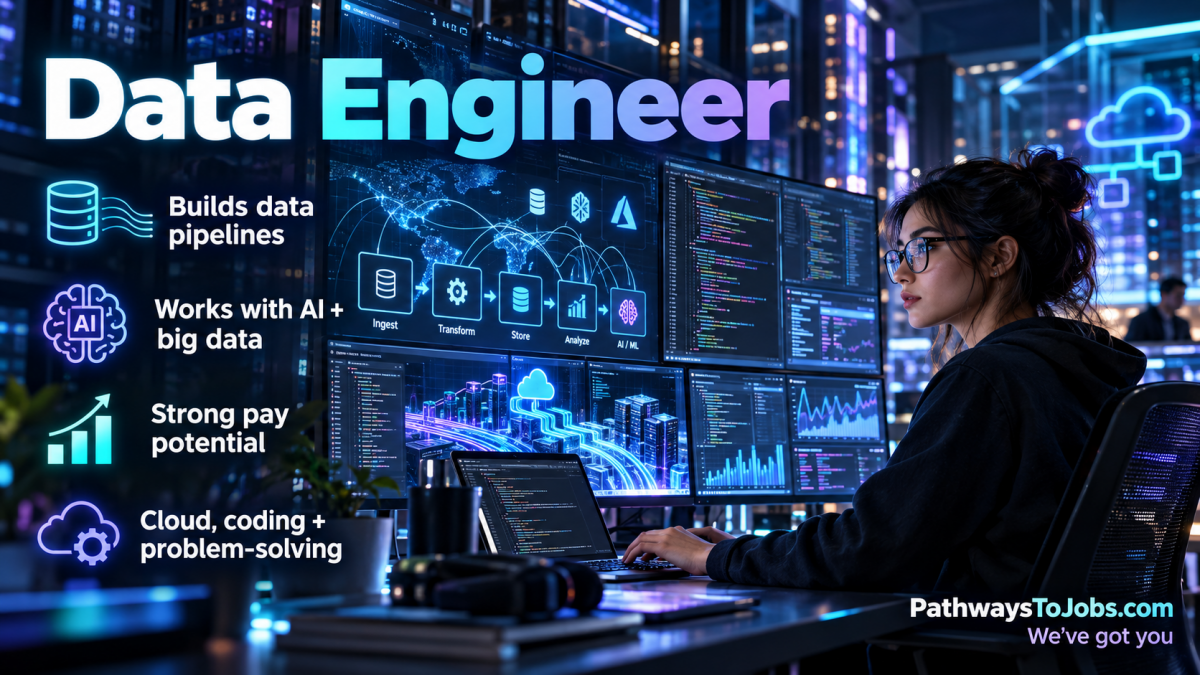
Data Engineers build the systems that collect, organize, move, and store huge amounts of information. They create data pipelines that bring information together from websites, apps, sensors, business systems, and other sources so it can be used by analysts, software applications, and artificial intelligence. Their work helps make sure data is accurate, secure and available when it is needed. Data Engineers work with databases, cloud platforms, programming languages and automated data-processing tools.
Education
Most Data Engineers have a bachelor’s degree in computer science, information technology, software engineering, data science, or a related field. College or technical programs in database development, cloud computing, or data analytics can also lead into the field, particularly when combined with strong programming and database skills. Common technologies include SQL, Python, cloud platforms, and database systems. Employers may also value certifications in cloud computing, database technology, or data engineering.
Work Environment
Data Engineers work for technology companies, banks, healthcare organizations, retailers, governments, manufacturers, consulting firms, and almost any organization that handles large amounts of information. Most work in offices or remotely and spend much of their day working with computers, databases, and cloud systems. They often work with data scientists, AI engineers, software developers, cybersecurity teams, and business analysts. Most positions are full-time.
Future Outlook
Data has become essential to artificial intelligence, automation, and digital business. As organizations collect more information, they need reliable systems to organize, move, store, and protect it. Data Engineers will continue to be needed to build the infrastructure behind AI, cloud computing, analytics, and other digital technologies. As these systems become more advanced, demand for people who can manage complex data environments is expected to remain strong across many industries around the world.
Recommended High School Courses
- Computer Science
- Calculus
- Physics
- Advanced Functions
- Mathematics
- Statistics
- Information Tech
- Data Management
- Cloud Computing - Work with cloud platforms to store data, run applications, and support large-scale data systems.
- Communicatiion - Sharing ideas clearly and understanding what others need from an AI system.
- Critical Thinking - Using logic and reasoning to identify the strengths and weaknesses of alternative solutions, conclusions or approaches to problems.
- Data Modelling - Design the structure of data so different systems can store, connect, and use information efficiently.
- Data Quality Management - Data Quality Management: Check data for accuracy, completeness, and consistency, and correct problems that could affect analysis or AI systems.
- Database Management - Create, maintain, secure, and improve databases so information remains accurate, organized, and easy to access.
- Problem-Solving: - Identify data or system issues, determine the cause, and develop practical solutions.
- Programming - Using coding skills to work with AI systems, software, and automated processes.
- SQL - Use Structured Query Language to retrieve, organize, update, and manage data stored in databases.
- Systems Analysis - Determining how a system should work and how changes in conditions, operations, and the environment will affect outcomes.
- Troubleshooting - Determining causes of operating errors and deciding what to do about it.
- Automation - Understanding how technology and AI can perform tasks automatically to save time and improve efficiency.
- Cloud Computing Basics: - Understand how data, applications, and services are stored and accessed through remote servers and cloud platforms.
- Cloud Systems: - Understand cloud platforms and services used to store, process, and manage data across large-scale digital environments
- Computers and Electronics - Understands computer hardware, electronic circuits, software and digital systems used in modern medical equipment.
- Cybersecurity - Knowledge of how to protect computer systems, networks, and data from unauthorized access, attacks, and damage.
- Data and Information - Understanding how data is collected, organized, analyzed, and used by AI systems.
- Data Architecture: - Understand how data is structured, connected, stored, and moved between systems to support business, analytics, and AI applications.
- Databases - Understand how databases are designed, organized, accessed, and maintained so large amounts of information can be used efficiently.
- Information Systems - Information Systems: Understand how people, technology, databases, and business processes work together to manage and use information.
- Mathematics - Knowledge of arithmetic, algebra, geometry, calculus, statistics, and their applications.
- Software Development - Understand how software is designed, built, tested, and maintained so data systems can work reliably with other applications.
- Analytical thinking - Examine complex data, systems, and problems, and identify patterns, relationships, or issues that need attention.
- Attention to Detail - Work carefully with code, databases, and data structures where small errors can cause larger problems.
- Complex Problem Solving - Identifying complex problems and reviewing related information to develop and evaluate options and implement solutions.See more occupations related to this skill.
- Information Organization - Arrange large amounts of data and technical information so it can be stored, accessed, and used efficiently.
- Learning New Technologies - Adapt to new programming tools, cloud platforms, databases, and AI technologies as the field continues to change.
- Logical Reasoning - Use step-by-step thinking to design data processes, understand how systems connect, and solve technical problems.
- Problem Recognition - Problem Recognition: Notice when data, software, or system performance is not working as expected, and identify where the problem may be coming from.
- Written Comprehension - The ability to read and understand information and ideas presented in writing.
- Build and maintain data pipelines
- Combine information from multiple systems
- Design database structures
- Clean and validate data
- Automate data-processing tasks
- Monitor data systems
- Troubleshoot failures
- Protect sensitive information
- Support AI and analytics systems
- Work with software and data teams
Schools


Potential Scholarships
Approx Salary Expectation
Related Careers


References
Statistics Canada – Labour Force
U.S. Bureau of Labor Statistics – Occupational Outlook Handbook U O*NET OnLine