Astrobiologist
Astrobiologist
Career Overview
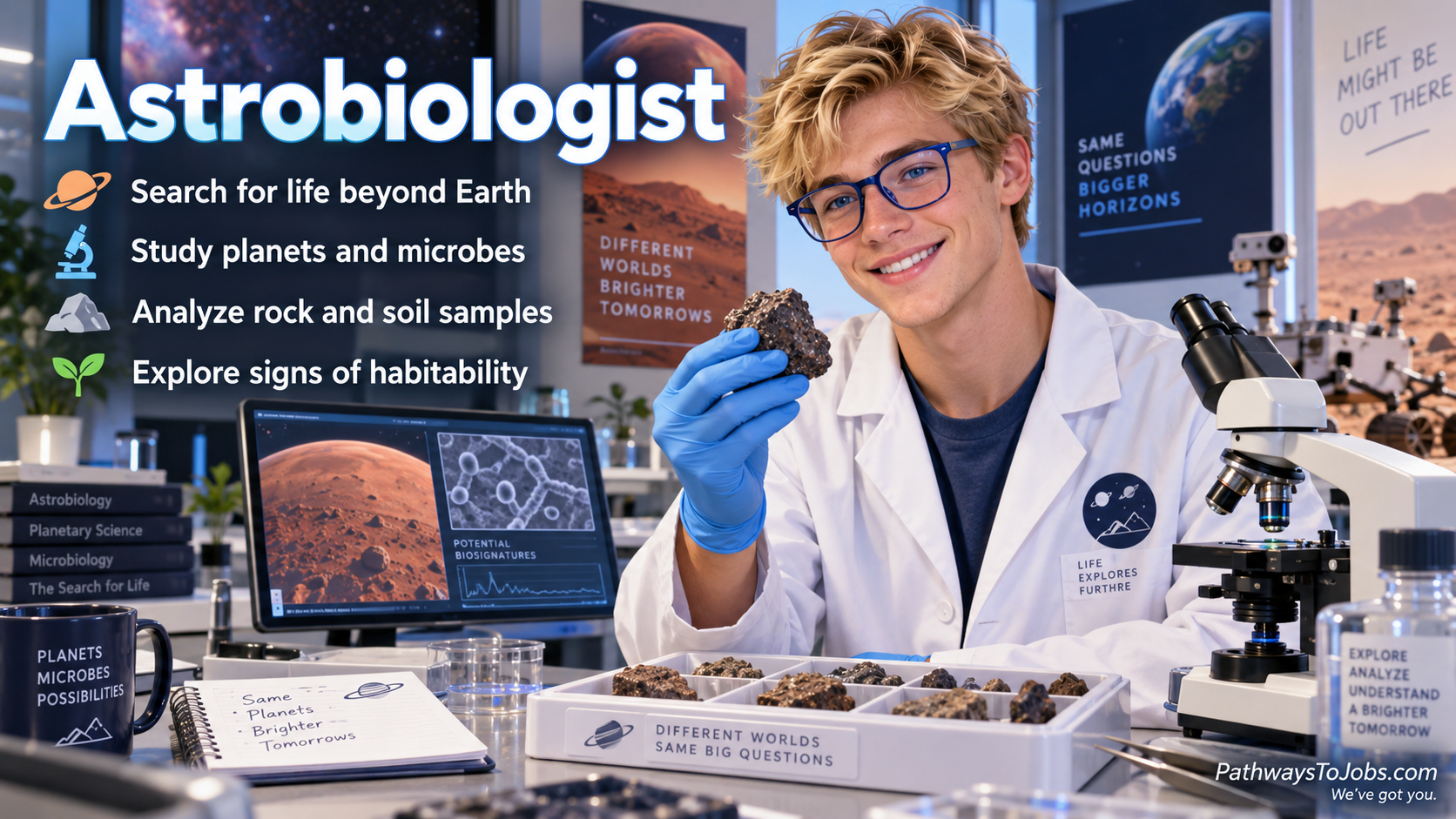
Astrobiologists study the origins, evolution, and potential for life beyond Earth, as well as the conditions that make life possible. They combine biology, chemistry, geology, planetary science, and astronomy to investigate questions about life on Earth and the possibility of life elsewhere in the universe. Their research may involve studying extreme environments on Earth, analyzing planetary materials, or examining data from space missions and telescopes.
Education
Astrobiology is an interdisciplinary field, so most students begin with a bachelor's degree in biology, chemistry, physics, geology, astronomy, or planetary science. Advanced research positions usually require a master's degree or Ph.D., often with specialized research in astrobiology or a related scientific field. NASA recommends developing expertise in a core scientific discipline before moving into advanced astrobiology research
Work Environment
Astrobiologists work in universities and government research programs, laboratories, observatories, research centres, and organizations involved in space science. Their work may involve laboratory experiments, field research in extreme environments, computer-based analysis, and collaboration with scientists from different disciplines. Some researchers contribute to space missions, planetary exploration, or the search for signs of life beyond Earth.
Future Outlook
Astrobiology is a specialized research field connected to growing interest in planetary exploration, the search for habitable environments, and the origins of life. Advances in space missions, laboratory science, imaging, data analysis, and planetary research are expanding what scientists can investigate about Mars, icy moons, exoplanets, and life on Earth. Students who build strong skills in biology, chemistry, physics, mathematics, and scientific research can prepare for opportunities in astrobiology and related fields of space and planetary science.
Recommended High School Courses
- Chemistry
- Biology
- Math
- Computer Science
- Microbiology
- Physics
- Earth & Space Science
- Active Learning - Understanding the implications of new information for both current and future problem-solving and decision-making.
- Active Listening - Giving full attention to what other people are saying, taking time to understand the points being made, asking questions as appropriate, and not interrupting at inappropriate times.
- Complex Problem Solving - Identifying complex problems and reviewing related information to develop and evaluate options and implement solutions.
- Coordination - Adjusting actions in relation to others' actions.
- Critical Thinking - Using logic and reasoning to identify the strengths and weaknesses of alternative solutions, conclusions or approaches to problems.
- Instructing - Teaching others how to do something.
- Judgment and Decision Making - Considering the relative costs and benefits of potential actions to choose the most appropriate one.
- Learning Strategies - Selecting and using training/instructional methods and procedures appropriate for the situation when learning or teaching new things.
- Management of Personnel Resources - Motivating, developing, and directing people as they work, identifying the best people for the job.
- Mathematics - Using mathematics to solve problems.
- Monitoring - Monitoring/Assessing performance of yourself, other individuals, or organizations to make improvements or take corrective action.
- Quality Control Analysis - Conducting tests and inspections of products, services, or processes to evaluate quality or performance.
- Reading Comprehension - Understanding written sentences and paragraphs in work related documents.
- Science - Using scientific rules and methods to solve problems.
- Social Perceptiveness - Being aware of others' reactions and understanding why they react as they do.
- Speaking - Talking to others to convey information effectively.
- Systems Analysis - Determining how a system should work and how changes in conditions, operations, and the environment will affect outcomes.
- Systems Evaluation - Identifying measures or indicators of system performance and the actions needed to improve or correct performance, relative to the goals of the system.
- Time Management - Managing one's own time and the time of others.
- Writing - Communicating effectively in writing as appropriate for the needs of the audience.
- Biology - Knowledge of plant and animal organisms, their tissues, cells, functions, interdependencies, and interactions with each other and the environment.
- Chemistry - Knowledge of the chemical composition, structure, and properties of substances and of the chemical processes and transformations that they undergo. This includes uses of chemicals and their interactions, danger signs, production techniques, and disposal methods.
- Education and Training - Knowledge of principles and methods for curriculum and training design, teaching and instruction for individuals and groups, and the measurement of training effects.
- English Language - Knowledge of the structure and content of the English language including the meaning and spelling of words, rules of composition, and grammar.
- Mathematics - Knowledge of arithmetic, algebra, geometry, calculus, statistics, and their applications.
- Category Flexibility - The ability to generate or use different sets of rules for combining or grouping things in different ways.
- Deductive Reasoning - The ability to apply general rules to specific problems to produce answers that make sense.
- Far Vision - The ability to see details at a distance.
- Finger Dexterity - The ability to make precisely coordinated movements of the fingers of one or both hands to grasp, manipulate, or assemble very small objects.
- Flexibility of Closure - The ability to identify or detect a known pattern (a figure, object, word, or sound) that is hidden in other distracting material.
- Fluency of Ideas - The ability to come up with a number of ideas about a topic (the number of ideas is important, not their quality, correctness, or creativity).
- Inductive Reasoning - The ability to combine pieces of information to form general rules or conclusions (includes finding a relationship among seemingly unrelated events).
- Information Ordering - The ability to arrange things or actions in a certain order or pattern according to a specific rule or set of rules (e.g., patterns of numbers, letters, words, pictures, mathematical operations).
- Mathematical Reasoning - The ability to choose the right mathematical methods or formulas to solve a problem.
- Near Vision - The ability to see details at close range (within a few feet of the observer).
- Number Facility - The ability to add, subtract, multiply, or divide quickly and correctly.
- Oral Comprehension - The ability to listen to and understand information and ideas presented through spoken words and sentences.
- Oral Expression - The ability to communicate information and ideas in speaking so others will understand.
- Originality - The ability to come up with unusual or clever ideas about a given topic or situation, or to develop creative ways to solve a problem.
- Perceptual Speed - The ability to quickly and accurately compare similarities and differences among sets of letters, numbers, objects, pictures, or patterns. The things to be compared may be presented at the same time or one after the other. This ability also includes comparing a presented object with a remembered object.
- Problem Sensitivity - The ability to tell when something is wrong or is likely to go wrong. It does not involve solving the problem, only recognizing there is a problem.
- Selective Attention - The ability to concentrate on a task over a period of time without being distracted.
- Speech Clarity - The ability to speak clearly so others can understand you.
- Speech Recognition - The ability to identify and understand the speech of another person.
- Speed of Closure - The ability to quickly make sense of, combine, and organize information into meaningful patterns.
- Visualization - The ability to imagine how something will look after it is moved around or when its parts are moved or rearranged.
- Written Comprehension - The ability to read and understand information and ideas presented in writing.
- Written Expression - The ability to communicate information and ideas in writing so others will understand.
- Record research or operational data.
- Plan biological research.
- Analyze biological samples.
- Research microbiological or chemical processes or structures.
- Supervise scientific or technical personnel.
- Direct scientific activities.
- Prepare scientific or technical reports or presentations.
- Instruct college students in physical or life sciences.
- Operate laboratory or field equipment.
- Develop biological research methods.
- Coordinate cross-disciplinary research programs.
- Evaluate new technologies or methods.
- Direct medical science or healthcare programs.
- Establish standards for medical care.
- Inspect equipment to ensure proper functioning.
- Manage scientific or technical project resources.
- Develop new or advanced products or production methods.
- Research crop management methods.
- Develop technical or scientific databases.
Schools


Potential Scholarships
Approx Salary Expectation
Related Careers



References
Trend Analysis - Explorer the Market, Labour Market Information, Government of Canada https://www.jobbank.gc.ca/trend-analysis.
Astrobiology at NASA, https://astrobiology.nasa.gov/
O*NET OnLine, National Center for O*NET Development, https://www.onetonline.org/.