Brewmaster
Brewmaster
Career Overview
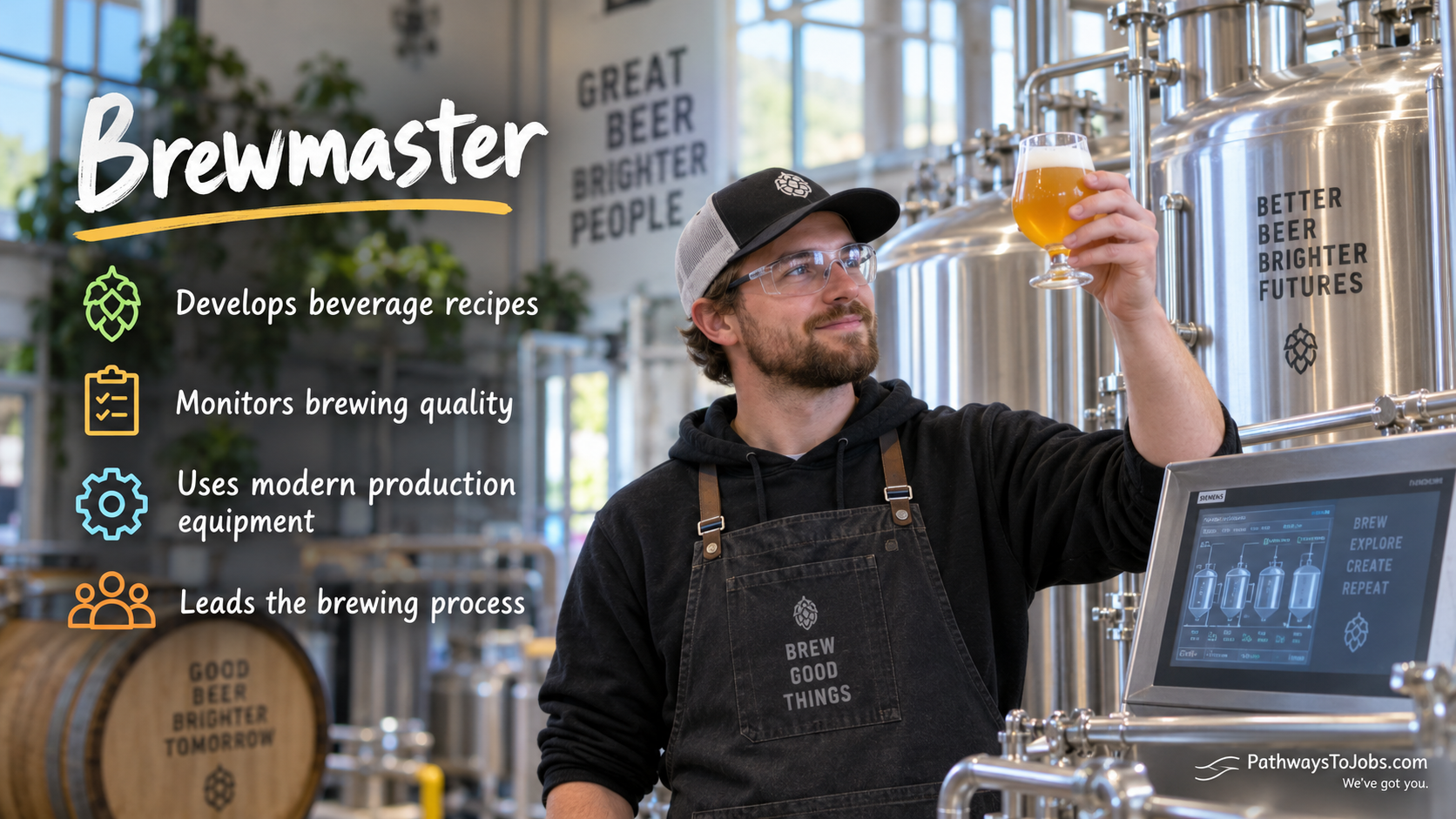
A Brewmaster creates and oversees the production of beer, from choosing ingredients and developing recipes to brewing, fermentation, quality testing, and packaging. The job combines science, creativity, technology, and leadership. Modern breweries use automated equipment, sensors, and computer systems to monitor the brewing process.
Education
A college or university program in Brewing Science, Brewery Operations, Food Science, Chemistry, Microbiology, or a related field can prepare you for this career. Hands-on brewery experience is also important, and becoming a Brewmaster usually requires several years of industry experience.
Work Environment
Brewmasters work in breweries, where the environment can be busy, noisy, hot, cold, or wet. They work with brewing equipment, computers, laboratory testing, and production teams, and must follow food-safety and workplace-safety procedures.
Future Outlook
Brewing continues to combine traditional skills with science, automation, and new technology. Opportunities are available in craft breweries, large beverage companies, quality control, product development, and brewery management. Canada's current outlook for the broader manufacturing-management category that includes Brewmasters is Moderate in several regions
Recommended High School Courses
- Chemistry
- Biology
- Math
- Computer Science
- Business
- Physics
- Food Production - Knowledge of techniques and equipment for planting, growing, and harvesting food products (both plant and animal) for consumption, including storage/handling techniques.
- Mathematics - Knowledge of arithmetic, algebra, geometry, calculus, statistics, and their applications.
- Mechanical - Knowledge of machines and tools, including their designs, uses, repair, and maintenance.
- Production and Processing - Knowledge of raw materials, production processes, quality control, costs, and other techniques for maximizing the effective manufacture and distribution of goods.
- Public Safety and Security - Knowledge of relevant equipment, policies, procedures, and strategies to promote effective local, state, or national security operations for the protection of people, data, property, and institutions.
- Active Listening - Giving full attention to what other people are saying, taking time to understand the points being made, asking questions as appropriate, and not interrupting at inappropriate times.
- Coordination - Adjusting actions in relation to others' actions.
- Critical Thinking - Using logic and reasoning to identify the strengths and weaknesses of alternative solutions, conclusions or approaches to problems.
- Monitoring - Monitoring/Assessing performance of yourself, other individuals, or organizations to make improvements or take corrective action.
- Operation and Control - Controlling operations of equipment or systems.
- Operation Monitoring - Watching gauges, dials, or other indicators to make sure a machine is working properly.
- Reading Comprehension - Understanding written sentences and paragraphs in work related documents.
- Speaking - Talking to others to convey information effectively.
- Writing - Communicating effectively in writing as appropriate for the needs of the audience.
- Information Ordering — The ability to arrange things or actions in a certain order or pattern according to a specific rule or set of rules (e.g., patterns of numbers, letters, words, pictures, mathematical operations).
- Near Vision — The ability to see details at close range (within a few feet of the observer).
- Oral Comprehension — The ability to listen to and understand information and ideas presented through spoken words and sentences.
- Problem Sensitivity — The ability to tell when something is wrong or is likely to go wrong. It does not involve solving the problem, only recognizing there is a problem.
- Arm-Hand Steadiness — The ability to keep your hand and arm steady while moving your arm or while holding your arm and hand in one position.
- Control Precision — The ability to quickly and repeatedly adjust the controls of a machine or a vehicle to exact positions.
- Manual Dexterity — The ability to quickly move your hand, your hand together with your arm, or your two hands to grasp, manipulate, or assemble objects.
- Written Comprehension — The ability to read and understand information and ideas presented in writing.
- Category Flexibility — The ability to generate or use different sets of rules for combining or grouping things in different ways.
- Deductive Reasoning — The ability to apply general rules to specific problems to produce answers that make sense.
- Finger Dexterity — The ability to make precisely coordinated movements of the fingers of one or both hands to grasp, manipulate, or assemble very small objects.
- Oral Expression — The ability to communicate information and ideas in speaking so others will understand.
- Perceptual Speed — The ability to quickly and accurately compare similarities and differences among sets of letters, numbers, objects, pictures, or patterns. The things to be compared may be presented at the same time or one after the other. This ability also includes comparing a presented object with a remembered object.
- Selective Attention — The ability to concentrate on a task over a period of time without being distracted.
- Speech Clarity — The ability to speak clearly so others can understand you.
- Speech Recognition — The ability to identify and understand the speech of another person.
Schools


Potential Scholarships
Approx Salary Expectation




References
PayScale, Inc., https://www.payscale.com/.
O*NET OnLine, National Center for O*NET Development, https://www.onetonline.org/.