Security Guard
Security Guard
Career Overview
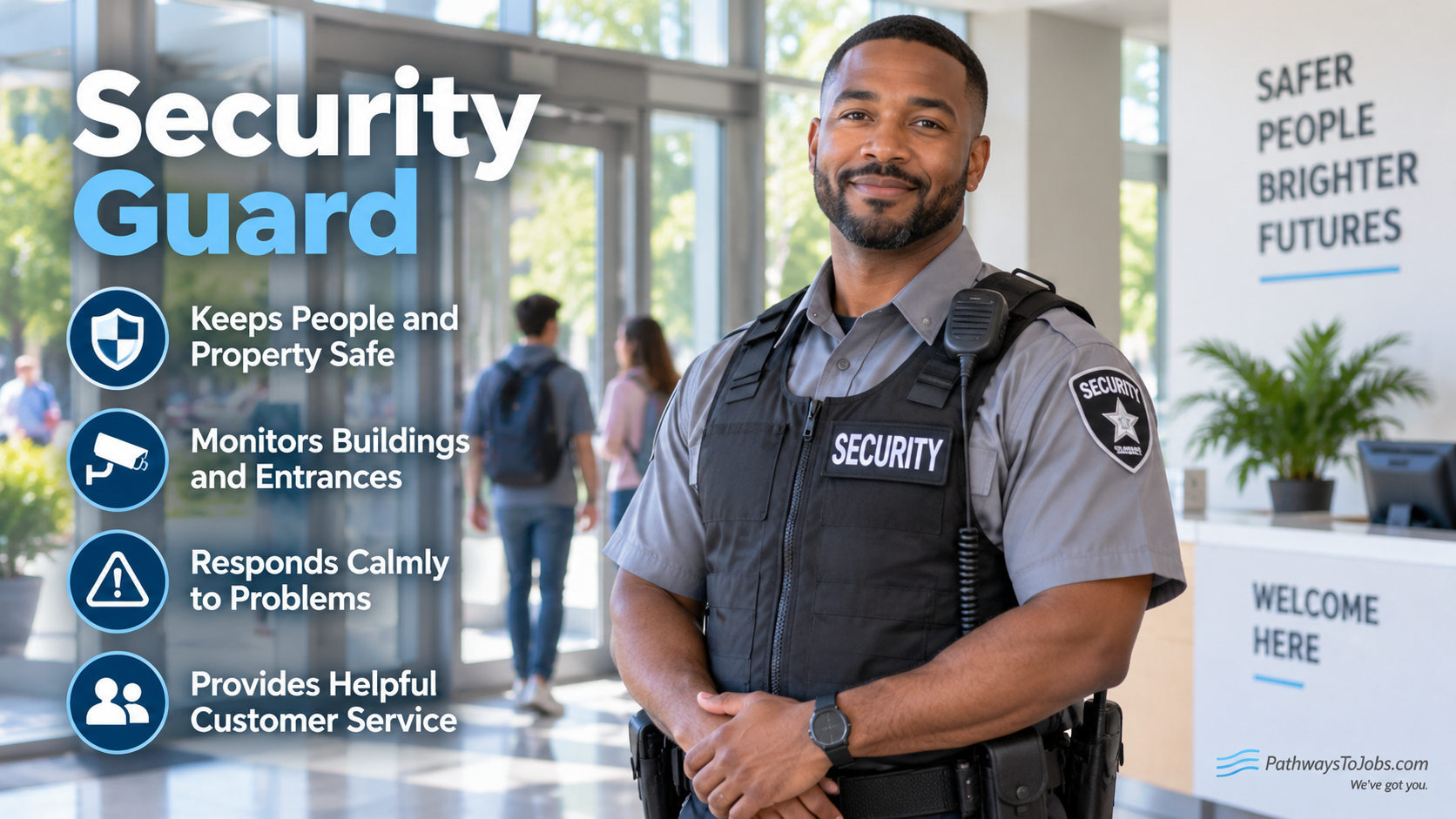
Security guards protect people, property, and facilities from theft, vandalism, and other threats. They monitor security cameras, control access, respond to incidents, and write reports. Modern security work increasingly uses AI-enabled surveillance, alarms, access-control systems, and other security technology.
Education
A high school diploma or equivalent is typically required. Training and licensing requirements vary by location and may include security training, first aid, CPR, or specialized training for armed security work.
Work Environment
Security guards work in offices, stores, hospitals, schools, industrial facilities, airports, residential buildings, and other locations. The work can involve standing, walking, monitoring cameras, and responding to incidents. Evening, overnight, weekend, and holiday shifts are common.
Future Outlook
Security remains important as organizations protect people, property, and information. AI-powered cameras, remote monitoring, biometrics, and access-control technology are changing the work, creating opportunities for guards who are comfortable with modern security systems.
Recommended High School Courses
- Psychology
- Math
- Physical Education
- English
- Computer Studies
- Law
- Active Learning - Understanding the implications of new information for both current and future problem-solving and decision-making.
- Active Listening - Giving full attention to what other people are saying, taking time to understand the points being made, asking questions as appropriate, and not interrupting at inappropriate times.
- Coordination - Adjusting actions in relation to others' actions.
- Critical Thinking - Using logic and reasoning to identify the strengths and weaknesses of alternative solutions, conclusions or approaches to problems.
- Monitoring - Monitoring/Assessing performance of yourself, other individuals, or organizations to make improvements or take corrective action.
- Reading Comprehension - Understanding written sentences and paragraphs in work related documents.
- Social Perceptiveness - Being aware of others' reactions and understanding why they react as they do.
- Speaking - Talking to others to convey information effectively.
- Writing - Communicating effectively in writing as appropriate for the needs of the audience.
- Customer and Personal Service - Knowledge of principles and processes for providing customer and personal services. This includes customer needs assessment, meeting quality standards for services, and evaluation of customer satisfaction.
- English Language - Knowledge of the structure and content of the English language including the meaning and spelling of words, rules of composition, and grammar.
- Public Safety and Security - Knowledge of relevant equipment, policies, procedures, and strategies to promote effective local, state, or national security operations for the protection of people, data, property, and institutions.
- Deductive Reasoning - The ability to apply general rules to specific problems to produce answers that make sense.
- Far Vision - The ability to see details at a distance.
- Flexibility of Closure - The ability to identify or detect a known pattern (a figure, object, word, or sound) that is hidden in other distracting material.
- Inductive Reasoning - The ability to combine pieces of information to form general rules or conclusions (includes finding a relationship among seemingly unrelated events).
- Near Vision - The ability to see details at close range (within a few feet of the observer).
- Oral Comprehension - The ability to listen to and understand information and ideas presented through spoken words and sentences.
- Oral Expression - The ability to communicate information and ideas in speaking so others will understand.
- Perceptual Speed - The ability to quickly and accurately compare similarities and differences among sets of letters, numbers, objects, pictures, or patterns. The things to be compared may be presented at the same time or one after the other. This ability also includes comparing a presented object with a remembered object.
- Problem Sensitivity - The ability to tell when something is wrong or is likely to go wrong. It does not involve solving the problem, only recognizing there is a problem.
- Selective Attention - The ability to concentrate on a task over a period of time without being distracted.
- Speech Clarity - The ability to speak clearly so others can understand you.
- Speech Recognition - The ability to identify and understand the speech of another person.
- Block physical access to restricted areas.
- Investigate illegal or suspicious activities.
- Respond to emergencies to provide assistance.
- Monitor access or flow of people to prevent problems.
- Prevent unauthorized individuals from entering restricted areas.
- Write operational reports.
- Operate surveillance equipment to detect suspicious or illegal activities.
- Patrol properties to maintain safety.
- Request emergency personnel.
- Maintain public order or security.
- Provide first aid or rescue assistance in emergencies.
- Use weapons or physical force to maintain security.
- Warn individuals about rule violations or safety concerns.
- Inspect equipment to ensure safety or proper functioning.
- Drive vehicles to transport individuals or equipment.
Schools


Potential Scholarships
Approx Salary Expectation
References
Trend Analysis - Explorer the Market, Labour Market Information, Government of Canada https://www.jobbank.gc.ca/trend-analysis.
O*NET OnLine, National Center for O*NET Development, https://www.onetonline.org/.